riwaya.

riwaya.🇲🇦
Nous utilisons des cookies pour améliorer votre expérience, analyser notre trafic et vous proposer des offres personnalisées. En savoir plus dans notre Politique de confidentialité.

باولو كويلو
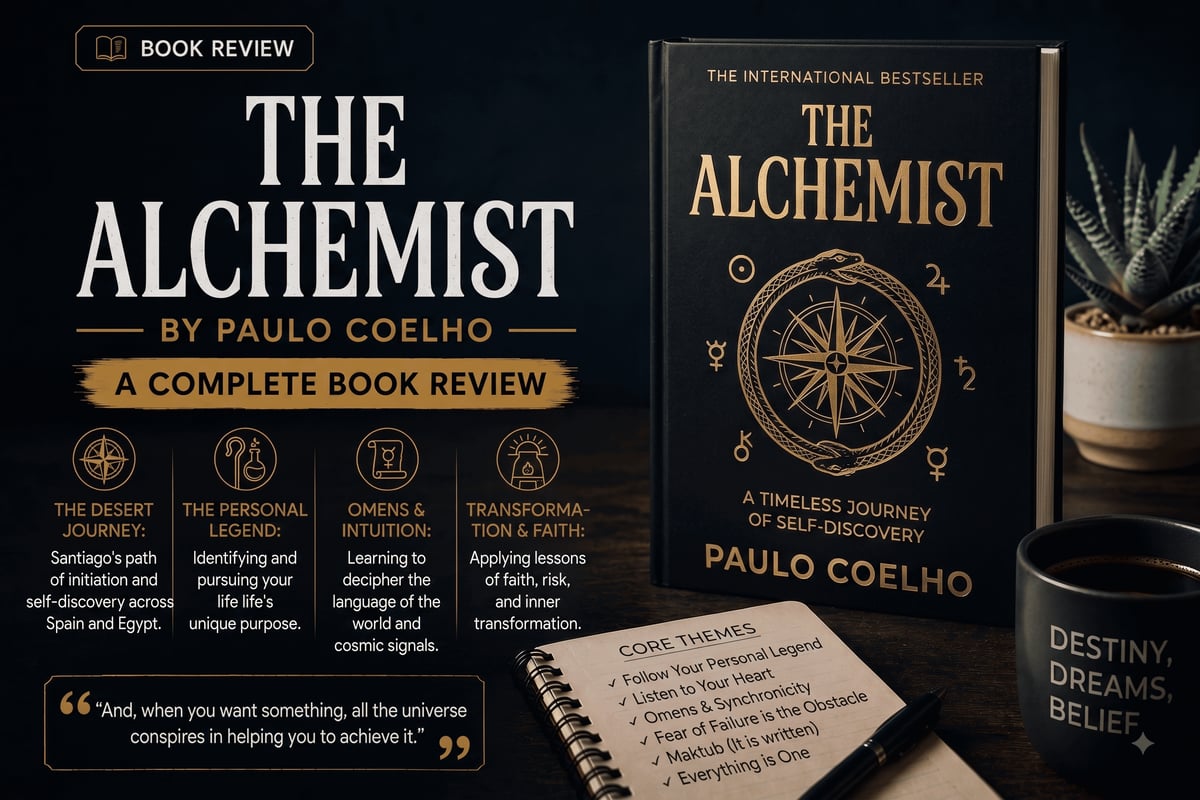
The Alchemist is Paulo Coelho's enchanting novel about a young shepherd's quest to realize his Personal Legend. A timeless fable of following your dreams.
Cet article a été écrit par Sarah Jenkins.
The Alchemist is Paulo Coelho's enchanting novel about a young shepherd's quest to realize his Personal Legend. A timeless fable of following your dreams.

The Alchemist by Paulo Coelho is one of the most recognizable modern novels about dreams, purpose, courage, and self-discovery. First published in Portuguese in 1988, the novel follows Santiago, a young Andalusian shepherd who decides to leave the familiar world behind after experiencing a recurring dream about a treasure near the Egyptian pyramids.
What begins as a simple search for treasure gradually becomes a much deeper journey. Santiago encounters strangers, merchants, travelers, teachers, setbacks, and moments of profound uncertainty. Each experience forces him to reconsider what he believes about fear, success, love, work, destiny, and the meaning of his own life.
The novel's enduring appeal comes partly from its simplicity. Coelho does not present his ideas through complicated philosophical arguments. Instead, he uses a fable-like story to explore questions that many people eventually confront: What do I truly want? What prevents me from pursuing it? How do I recognize opportunities? What happens when the path becomes difficult?
Although the story has strong spiritual elements, its themes can be interpreted in different ways. Some readers approach it as a spiritual parable, others as a motivational story, and others as a reflection on personal identity and the courage required to pursue meaningful goals.
That flexibility is one reason the novel continues to resonate with readers across generations.
Des livres soigneusement sélectionnés pour tous les goûts aux meilleurs prix.
Paulo Coelho is a Brazilian author whose novels have made him one of the most widely read contemporary writers in the world.
His writing frequently explores spirituality, personal transformation, faith, destiny, and the search for meaning. Rather than constructing highly complex literary worlds, Coelho often uses relatively simple narratives to communicate philosophical ideas.
The Alchemist became particularly important in establishing his international reputation. Its story is accessible enough for a teenager discovering the book for the first time, while its themes can take on very different meanings when encountered later in life.
A reader discovering the novel at eighteen may see Santiago's journey as a story about pursuing dreams. Someone reading it at forty may interpret it differently, perhaps focusing on regret, opportunity, sacrifice, or the consequences of choosing security over personal fulfillment.
The novel begins with Santiago, a young shepherd from Andalusia who has chosen a relatively simple life traveling with his flock.
Although he enjoys the freedom of his life, he experiences a recurring dream involving a treasure located near the Egyptian pyramids.
Santiago initially does not know whether the dream should be taken seriously. Eventually, however, his curiosity leads him to seek guidance and consider pursuing the treasure.
His decision changes everything.
He sells his sheep and travels beyond the familiar environment he knows. His journey takes him across countries and introduces him to people with completely different experiences and ambitions.
Along the way, Santiago loses things, gains knowledge, encounters disappointment, falls in love, works for a living, and learns to pay attention to the world around him.
The physical journey therefore becomes a metaphor for an internal transformation.
Santiago is not presented as an extraordinary hero at the beginning of the story.
He is young, inexperienced, and uncertain.
This is important because it allows readers to identify with him.
He does not possess all the answers.
He makes mistakes.
He becomes afraid.
He sometimes doubts his decisions.
He experiences setbacks that make him question whether leaving home was the right choice.
His development therefore does not come from suddenly becoming fearless. Instead, he gradually becomes better at understanding uncertainty and continuing despite it.
That makes Santiago's journey particularly relevant to anyone facing a major decision.
The central concept in The Alchemist is the idea of the Personal Legend.
A Personal Legend can be understood as a person's deepest calling or meaningful purpose—the path they feel they are meant to pursue.
The concept is presented through the novel's spiritual worldview, but it can also be interpreted in a more secular way.
For a modern reader, a Personal Legend might represent a meaningful ambition, creative project, professional vocation, relationship, contribution to society, or personal transformation.
The important question is not necessarily whether everyone has one predetermined destiny.
Instead, the concept encourages readers to ask:
What kind of life would feel genuinely meaningful to me?
One of the novel's most interesting distinctions is between simply wishing for something and being willing to pursue it.
Almost everyone has dreams.
People dream of traveling, building businesses, writing books, changing careers, creating art, helping others, or achieving financial independence.
But a dream becomes significantly more demanding when action is required.
Santiago has to leave familiar surroundings.
He has to accept uncertainty.
He has to work.
He has to recover after setbacks.
He has to keep moving even when the original plan becomes difficult.
This is one of the book's most practical lessons: a meaningful aspiration eventually demands a willingness to act.
The novel repeatedly examines fear.
Sometimes the greatest obstacle is not the external challenge itself but the possibility of failure.
People may fear losing what they already have.
They may fear embarrassment.
They may fear disappointing others.
They may fear making the wrong decision.
They may fear discovering that the dream they pursued was not what they expected.
Santiago experiences versions of these fears throughout the story.
His journey suggests that uncertainty is not necessarily evidence that a decision is wrong.
Sometimes uncertainty is simply a natural part of doing something unfamiliar.
One of the strongest interpretations of Santiago's journey is that courage is not the elimination of fear.
If courage required complete confidence, very few people would ever demonstrate it.
Courage can instead mean acting while uncertainty remains.
A student can apply for an opportunity despite worrying about rejection.
An entrepreneur can launch a product without knowing exactly how customers will respond.
A writer can publish something knowing that criticism is possible.
Someone changing careers can begin learning a new field before feeling completely ready.
The lesson is not to ignore risk.
It is to avoid allowing fear to automatically make every decision for you.
Santiago's journey begins when he leaves what he already knows.
This is significant because comfort can become a powerful form of inertia.
Familiar environments provide security.
They also provide predictability.
But predictability does not necessarily mean fulfillment.
The novel does not suggest that everyone should abandon their current life and travel across the world.
Its deeper message can be interpreted more broadly: meaningful growth often requires entering situations where you do not already know everything.
Learning a new skill, meeting new people, changing careers, starting a project, or exploring an unfamiliar environment can all create this experience.
One of the important figures Santiago encounters is an old king who introduces him to the idea of pursuing his Personal Legend.
The king functions partly as a mentor and partly as a symbolic figure.
His role demonstrates the importance of guidance when someone is uncertain about their direction.
In real life, mentors do not necessarily tell us exactly what to do.
A good mentor can instead ask better questions, share experience, challenge assumptions, and help us recognize possibilities that we cannot see clearly ourselves.
Santiago's encounters illustrate how different people can contribute to a person's development.
Some teach directly.
Others teach through mistakes.
Some provide opportunities.
Others create obstacles.
This is an important distinction.
Not every influential person in our lives is someone we admire.
Sometimes a difficult experience can teach us more about ourselves than an easy one.
The useful question is not always, "Was this person good or bad for me?"
It can also be:
"What did this experience teach me?"
The novel places considerable emphasis on omens.
Santiago learns to observe events and interpret them as signs that may guide his decisions.
This is one of the book's most spiritual ideas.
Readers do not have to interpret omens literally to find value in the concept.
A modern interpretation could be paying closer attention to patterns, opportunities, intuition, and information that we might otherwise overlook.
When people become deeply focused on a goal, they often begin noticing possibilities that were previously invisible to them.
This does not mean every coincidence is a message.
It means attention changes perception.
The book encourages Santiago to listen to his intuition, but modern readers should balance this idea with critical thinking.
Intuition can sometimes reflect accumulated experience.
An experienced professional may sense that something is wrong before being able to explain exactly why.
But intuition can also be influenced by assumptions, fear, bias, and incomplete information.
A useful modern approach is to treat intuition as a signal rather than an unquestionable command.
Notice the feeling.
Investigate it.
Look at the evidence.
Then make a decision.
Another important character is the Englishman, who is deeply interested in alchemy and the pursuit of knowledge.
His approach contrasts with Santiago's more experiential way of learning.
The Englishman studies books and theories.
Santiago learns through observation and experience.
The contrast raises an important question: Is knowledge primarily something we acquire through study, or something we develop through experience?
The novel suggests that both forms of learning matter, but experience plays a particularly important role in Santiago's transformation.
The idea of learning through experience remains highly relevant today.
Reading about entrepreneurship is not the same as speaking with customers.
Reading about programming is not the same as building software.
Reading about writing is not the same as completing an article.
Reading about leadership is not the same as managing a difficult team.
Books can provide frameworks and knowledge, but experience tests whether that knowledge actually works.
The Alchemist therefore encourages an active relationship with learning.
Study.
Experiment.
Observe.
Adjust.
Repeat.
Santiago's work with the crystal merchant represents one of the most practical parts of the story.
After experiencing setbacks, Santiago finds himself working for someone who has spent years living within the boundaries of his existing circumstances.
The merchant has dreams of his own, but fear and habit prevent him from fully pursuing them.
This creates a powerful contrast between Santiago and the merchant.
Both have desires.
The difference lies partly in their willingness to act.
Security is valuable.
A stable income, predictable routine, and comfortable environment can provide important foundations for life.
But security can become limiting when it becomes the only objective.
If someone continuously postpones meaningful ambitions because conditions are never "perfect," the perfect moment may never arrive.
The novel encourages readers to recognize the difference between responsible caution and permanent avoidance.
Taking calculated risks can be part of growth.
Although The Alchemist is often described as a spiritual book, it does not portray transformation as purely passive.
Santiago works.
He sells.
He observes.
He learns.
He makes decisions.
He adapts.
This is an important counterbalance to the book's mystical elements.
The pursuit of a meaningful goal still requires effort.
Dreams do not eliminate the need for practical work.
Santiago encounters setbacks that could easily convince him to abandon his journey.
At various points, he loses confidence and faces circumstances very different from what he originally imagined.
Yet these experiences become part of his education.
The novel does not suggest that every setback is secretly good or that every failure inevitably leads to success.
Instead, it presents difficulty as part of the journey.
A setback can change the path without necessarily destroying the destination.
A modern interpretation of the book can treat failure as information.
If a plan fails, you learn something.
If a business idea does not attract customers, you receive information about the market.
If a career choice makes you unhappy, you learn something about your preferences.
If a study method produces poor results, you can change the method.
Failure is painful, but it can become useful when analyzed honestly.
The key is avoiding the assumption that every failure defines your ability.
Love is another important theme in the novel.
Santiago meets Fatima and develops a deep emotional connection with her.
Their relationship introduces a difficult question: Can you pursue your own path without abandoning the person you love?
The novel's answer is that genuine love should not necessarily require the destruction of personal purpose.
This is a nuanced idea because relationships involve compromise, responsibility, and shared decisions.
The book presents love as something that can coexist with personal growth rather than automatically becoming an obstacle to it.
Fatima's role is particularly interesting because she does not simply represent romantic love.
She also represents understanding and trust.
The relationship challenges the idea that loving someone necessarily means keeping them physically close at all times.
In real relationships, healthy support can involve encouraging another person to grow while maintaining one's own identity.
The challenge is finding a balance between independence and commitment.
The Alchemist is the figure who helps Santiago understand the deeper meaning of his journey.
He represents knowledge, transformation, discipline, and spiritual understanding.
His teachings reinforce one of the novel's central messages: the journey requires attention.
Santiago must learn to observe.
He must listen.
He must recognize what matters.
He must distinguish genuine opportunities from distractions.
Alchemy traditionally refers to historical attempts to transform matter, particularly the pursuit of transforming base metals into gold.
In Coelho's novel, alchemy becomes a metaphor for personal transformation.
The "gold" is not simply physical wealth.
It can represent wisdom, self-knowledge, courage, and a transformed understanding of life.
The metaphor is particularly effective because Santiago himself changes throughout the journey.
The treasure he seeks becomes less important than the person he becomes while searching for it.
The concept of the Soul of the World gives the novel its broader spiritual dimension.
The idea suggests that everything is connected through a deeper universal force.
Different readers may interpret this concept differently.
Some may see it through a religious or spiritual lens.
Others may interpret it metaphorically as the interconnectedness of people, nature, experience, and human aspiration.
The novel does not require every reader to reach the same interpretation.
Its openness allows the idea to function as a personal reflection.
Another important lesson is the importance of being present.
Santiago has a destination, but he cannot reach it by mentally living only in the future.
He must pay attention to what is happening around him.
This reflects a common challenge in modern life.
People often spend enormous amounts of time worrying about future outcomes or replaying past mistakes.
The present moment can disappear between the two.
The novel encourages a more attentive way of living.
Perhaps the most enduring message of The Alchemist is that the journey itself has value.
Santiago begins with a very specific objective: finding treasure.
But the experiences along the way teach him about work, love, fear, courage, knowledge, and himself.
This suggests that goals should not be viewed only as destinations.
The person you become while pursuing the goal may be just as important as the outcome.
A career goal may teach discipline.
A failed business may teach resilience.
Travel may teach independence.
A difficult relationship may teach communication.
The destination matters, but so does the transformation.
The treasure in the novel can be interpreted literally within the story, but symbolically it represents something larger.
It can represent the discovery of one's own potential.
It can represent the realization that what we seek externally may ultimately lead us back to a deeper understanding of ourselves.
This is one reason the story is often described as a journey of self-discovery.
The physical search provides the structure.
The internal transformation provides the meaning.
Without revealing every detail of the ending, one of the novel's most memorable ideas is its use of irony.
Santiago travels a tremendous distance in search of something valuable.
His journey takes him away from home and exposes him to unfamiliar experiences.
Eventually, he gains an important realization about the relationship between the treasure he seeks and the place he started.
This creates one of the novel's central paradoxes:
Sometimes we have to travel far from ourselves to understand what was close to us all along.
Although the novel is a work of fiction, many of its themes overlap with modern personal development.
Goal setting encourages people to define what they want.
Career development encourages exploration and skill building.
Entrepreneurship requires risk management and persistence.
Mindfulness emphasizes attention to the present.
Coaching emphasizes self-awareness and purposeful action.
The Alchemist approaches these ideas through storytelling rather than through productivity frameworks.
That is what gives it its distinctive character.
Purpose does not necessarily mean discovering one perfect career or destiny.
For many people, purpose evolves.
Someone may begin with one ambition and discover that another path suits them better.
A student's interests can change.
A professional can discover a new vocation.
An entrepreneur can change industries.
A parent can redefine priorities.
The concept of a Personal Legend can therefore be interpreted as an invitation to remain attentive to what gives your life meaning.
There is also a danger in interpreting the novel too literally.
Not every dream should automatically be pursued regardless of consequences.
People have responsibilities.
Financial constraints matter.
Family obligations matter.
Health matters.
Risk matters.
A mature approach to purpose combines aspiration with practical judgment.
The question is not simply:
"Do I want this?"
It is also:
"What would pursuing this responsibly look like?"
Santiago repeatedly has to make decisions without complete certainty.
This resembles real life.
Nobody can know every consequence before making a major decision.
The challenge is to distinguish calculated risk from reckless behavior.
Calculated risk involves gathering information, understanding potential consequences, considering alternatives, and deciding what level of uncertainty is acceptable.
The novel's message is therefore most useful when combined with practical judgment.
Young readers often face questions about identity, education, career, relationships, and independence.
The Alchemist speaks directly to these uncertainties.
It tells readers that they do not need to have every answer immediately.
Exploration itself can be part of the process.
The story can therefore be especially powerful during periods of transition.
The novel can change meaning as the reader changes.
Someone who once viewed Santiago as a symbol of youthful ambition may later see the crystal merchant as the more relatable character.
The older reader may recognize the temptation to remain comfortable.
They may understand the fear of changing direction.
They may also appreciate the book's message about not postponing meaningful experiences indefinitely.
This is one reason the novel rewards rereading.
One of the book's greatest strengths is accessibility.
The language and story are relatively simple, allowing philosophical themes to emerge without requiring specialist knowledge.
The novel also uses symbolism effectively.
The desert, treasure, journey, omens, alchemy, and characters all contribute to the larger metaphor.
Another strength is its emotional optimism.
The story encourages readers to believe that personal growth remains possible even after disappointment.
The book is not universally appealing.
Some readers may find its spiritual worldview overly simplistic.
Others may feel that the idea of destiny reduces the complexity of real-world circumstances.
Some readers may also argue that the novel romanticizes following one's dreams without sufficiently emphasizing structural constraints and practical limitations.
These criticisms are worth considering.
A meaningful reading does not require agreeing with every philosophical premise.
The book can be appreciated as a literary fable while still questioning some of its assumptions.
Technically, The Alchemist is a novel rather than a conventional self-help book.
Its lessons are communicated through fiction.
This distinction matters.
Instead of giving readers a checklist of habits, Coelho invites them to experience Santiago's transformation through storytelling.
The lessons therefore operate emotionally as well as intellectually.
Readers may remember a scene or character long after forgetting a direct piece of advice from a nonfiction book.
Stories can communicate ideas differently from direct instruction.
If someone tells you, "You should not give up on your goals," the statement may be quickly forgotten.
If you follow a character through uncertainty, loss, hope, and persistence, the lesson can become emotionally meaningful.
This is one reason fiction can play an important role in personal development.
It allows readers to explore decisions through another person's experience.
The most practical way to read The Alchemist is not to copy Santiago's exact journey.
Instead, extract the questions behind his experience.
What dream have you been postponing?
What fear is influencing your decisions?
What would you attempt if you knew failure would teach you something?
Are you paying attention to opportunities?
Are you learning from your setbacks?
Are your relationships supporting your growth?
Are you so focused on a future destination that you are ignoring your current life?
These questions can turn a literary experience into personal reflection.
In 2026, the idea of a Personal Legend can be interpreted without assuming that everyone has one predetermined destiny.
It can simply mean identifying the direction that feels meaningful and deliberately building toward it.
Your Personal Legend might be becoming an excellent professional.
It might be creating a business.
It might be raising a family.
It might be producing art.
It might be serving your community.
It might be mastering a difficult skill.
It might even be building a quieter and more balanced life.
The important point is that meaning is personal.
The novel can be particularly useful for people questioning their professional direction.
A career decision should not be based only on prestige or income.
Those factors matter, but they are not the only considerations.
Interest, aptitude, lifestyle, values, growth opportunities, stability, and contribution can all matter.
The book encourages readers to ask whether the path they are following is genuinely theirs or simply something they inherited from expectations around them.
You do not always need to make a massive irreversible decision to discover what you want.
You can experiment.
Take a course.
Volunteer.
Build a small project.
Talk to professionals.
Freelance.
Write.
Travel.
Learn.
These experiences can provide information about what actually interests you.
Santiago's journey can therefore be interpreted as a long experiment in self-discovery.
The most useful interpretation of The Alchemist is not "follow every dream regardless of reality."
It is:
Take your meaningful aspirations seriously enough to investigate them.
Dreams deserve attention.
But they also deserve testing.
If you want to become a writer, write.
If you want to start a business, research the market.
If you want to change careers, learn about the field.
If you want to travel, understand the practical requirements.
Action turns an abstract dream into information.
A book about self-discovery can change meaning depending on the reader's stage of life.
The first reading may inspire you.
A later reading may challenge you.
Another reading may reveal themes you previously ignored.
You may identify with Santiago at one stage and with the crystal merchant at another.
You may initially focus on the treasure and later focus on the journey.
This is one of the defining characteristics of a book that remains relevant.
It changes because the reader changes.
The Alchemist by Paulo Coelho is much more than a story about a shepherd searching for treasure.
It is a literary journey through ambition, uncertainty, love, fear, work, spirituality, and self-discovery.
Santiago's adventure encourages readers to take their aspirations seriously while recognizing that pursuing a meaningful goal will rarely be completely comfortable.
The novel's concept of the Personal Legend remains its defining idea. Whether interpreted spiritually as destiny or more practically as a meaningful direction in life, it encourages an important question: What do you want your life to stand for?
The book also reminds us that progress rarely follows a perfectly predictable path.
Plans change.
People disappoint us.
Opportunities appear unexpectedly.
Failure can interrupt our plans.
Fear can make us hesitate.
Yet these experiences can also become part of our education.
The strongest lesson may therefore not be that the universe guarantees success to anyone who follows a dream. A more grounded interpretation is that people who clarify what matters to them, remain attentive to opportunities, learn from experience, and take thoughtful action are more likely to discover possibilities they would otherwise never encounter.
The Alchemist is ultimately a story about becoming more attentive to your own life.
It asks readers to look beyond comfort without glorifying recklessness, to pursue meaningful ambitions without ignoring reality, and to appreciate the journey rather than treating life as something that only becomes valuable once a destination has been reached.
For readers interested in personal growth, self-discovery, purpose, courage, and meaningful living, Paulo Coelho's novel remains an accessible and memorable classic.
And perhaps its most enduring message is this: sometimes the greatest treasure is not simply what we find at the end of the journey, but who we become while searching for it.
The enduring appeal of The Alchemist comes from its simplicity. Santiago's journey provides a narrative framework through which readers can reflect on dreams, fear, persistence and personal meaning.
We particularly appreciate the book's ability to encourage introspection without requiring the reader to understand complicated philosophical concepts. Its accessible style makes it possible for different generations to find different meanings in the same story.
At the same time, the book should not be interpreted literally as a promise that following a dream guarantees success. Real life involves uncertainty, constraints and unexpected circumstances. Its value is better understood as an invitation to examine what we genuinely want and whether fear is preventing us from pursuing it.
Soyez le premier à commenter !