
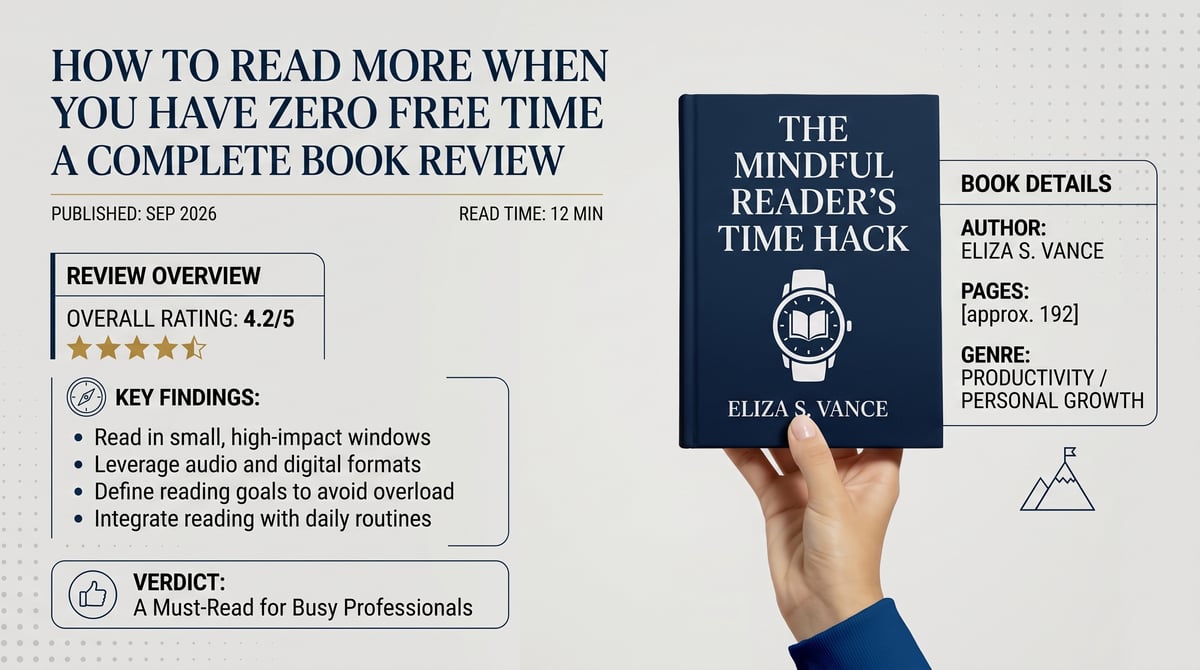

Résumé Rapide (TL;DR)
How To Read More When You Have Zero Free Time
Many people want to read more, but the same problem keeps coming up: there is simply not enough time.
Work takes most of the day. Family responsibilities fill the evening. Commuting consumes additional hours. Messages, emails, errands, and household tasks seem to multiply. By the time everything is finished, reading feels like one more responsibility rather than something enjoyable.
But there is an important distinction between having no free time and having no uninterrupted blocks of free time.
You may not have two hours available to sit quietly with a book. But you may have ten minutes in the morning, fifteen minutes before bed, twenty minutes on public transportation, or several small waiting periods throughout the day.
Those small moments can add up.
The secret to reading more is therefore not necessarily finding more time. It is learning how to use the small amounts of time you already have.
The Myth Of "Free Time"
The idea that you need a large block of uninterrupted time to read is one of the biggest obstacles to developing a reading habit.
People often imagine the ideal reading situation: a quiet room, a comfortable chair, no notifications, a cup of coffee, and perhaps an entire afternoon available.
That sounds wonderful.
It is also unrealistic for many people.
If you wait for the perfect moment, you may wait for weeks.
Instead, think about reading as an activity that can fit into small gaps. A book does not require a two-hour commitment. You can read five pages, close it, continue your day, and return later.
The important thing is continuity.
Where Does Your Time Actually Go?
Before deciding that you have no time to read, consider tracking how you spend your day.
Modern smartphones make this surprisingly easy.
You may discover that you spend fifteen minutes checking social media in the morning, twenty minutes scrolling during lunch, thirty minutes watching short videos in the evening, and another twenty minutes browsing your phone before bed.
That does not mean you need to eliminate entertainment.
Entertainment is part of life.
But it can reveal an important opportunity: your reading problem may not be a complete lack of time. It may be a competition for attention.
Reading Ten Pages A Day
One of the simplest strategies is to stop thinking in terms of hours.
Set a smaller target.
For example, read ten pages a day.
A typical reader might complete ten pages in roughly fifteen to twenty minutes, although reading speed varies significantly depending on the book and the individual.
A 300-page book would require approximately 30 days at ten pages per day.
That means a relatively small daily commitment can result in roughly one book per month.
Over an entire year, the same habit could potentially take you through around twelve books.
The power of the strategy comes from making the daily target small enough that it does not feel intimidating.
Why Small Goals Work
Large goals can create psychological resistance.
"Read 50 pages tonight" sounds like work.
"Read ten pages" sounds manageable.
Once you begin, you may naturally continue beyond your target.
But you do not need to.
If you stop after ten pages, you still succeeded.
This is important because a sustainable reading habit should not depend on motivation being perfect every day.
The Five-Page Version
If ten pages still feel like too much, reduce the target.
Read five pages.
The goal is not to prove how much discipline you have.
The goal is to create a behavior that survives busy days.
Five pages every day can become thirty-five pages per week.
Thirty-five pages per week becomes roughly 1800 pages per year.
Again, the exact number is less important than the principle.
Small actions become meaningful when repeated consistently.
Habit Stacking
One of the most effective ways to make reading easier is to attach it to something you already do.
This approach is often called habit stacking.
Instead of saying, "I will find time to read," create a specific connection between an existing routine and reading.
For example:
After making your morning coffee, read five pages.
After lunch, read for ten minutes.
After brushing your teeth at night, read one chapter.
After getting on the train, open your book.
The existing habit becomes the cue for the new one.
Read With Your Morning Coffee
If you already have a morning coffee or tea ritual, consider adding a few pages of reading.
You do not need to spend an hour.
Ten minutes can be enough.
The advantage is that the reading session becomes attached to something that already happens automatically.
You are not creating an entirely new routine.
You are modifying an existing one.
Read While Waiting
Waiting time is one of the most underestimated sources of reading opportunities.
Think about all the moments when you are doing nothing because someone else controls the schedule.
Waiting for an appointment.
Waiting at a restaurant.
Waiting for transportation.
Waiting for a meeting.
Waiting for food to cook.
Waiting for someone to arrive.
These small periods can become surprisingly productive reading opportunities.
Keep A Book With You
A reading habit becomes much easier when a book is immediately available.
If your book is at home while you spend most of the day elsewhere, you cannot easily use unexpected free moments.
Carry a physical book.
Or keep an ebook on your phone or reading device.
Or download an audiobook for situations where listening is more convenient.
The objective is simple:
Make reading available whenever an opportunity appears.
Make Reading Visible
Visibility matters.
If your book is hidden inside a drawer, you may forget about it.
If it is sitting beside your laptop, on your nightstand, or next to your coffee cup, it becomes a visual reminder.
The environment can therefore work as a cue.
You see the book.
You remember your goal.
You pick it up.
You read.
This is a small environmental change, but it can reduce the amount of mental effort required to start.
Replace A Small Amount Of Scrolling
You do not need to delete every social media application.
Instead, replace a small portion of your scrolling time.
If you normally spend twenty minutes scrolling before bed, try reading for ten minutes first.
If you still want to check your phone afterward, you can.
The objective is to gradually shift the balance of your attention.
Reading does not have to defeat entertainment completely.
It only needs to become part of the competition.
Use The "Before Screens" Rule
Another useful strategy is to read before opening your most distracting applications.
For example:
Read five pages before checking social media.
Or:
Read one chapter before watching television.
This creates a simple sequence.
The reading habit happens first.
Entertainment comes afterward.
Because the most stimulating activity often wins the competition for attention, giving reading the first opportunity can make a significant difference.
Audiobooks Count As Reading
If your schedule makes visual reading difficult, audiobooks can dramatically expand the amount of time available for books.
Listening allows you to experience books while performing activities that do not require your full linguistic attention.
You can listen while walking.
While cooking.
While cleaning.
During a commute.
During a long drive.
While doing repetitive household tasks.
These moments may not look like reading time, but they can become literary time.
Turn Your Commute Into Reading Time
Commuting can be one of the best opportunities for audiobooks.
A thirty-minute commute each way represents approximately one hour of potential listening time.
Across five working days, that can become around five hours per week.
Over a month, the amount becomes substantial.
Instead of trying to create new time, you are using time that already exists.
Listen While Walking
Walking and audiobooks can also work extremely well together.
A regular walk can become a routine where you listen to the same book every day.
This can create an interesting association: you begin looking forward to walking because you want to continue the story.
The audiobook becomes a source of motivation for another activity.
Listen While Doing Household Tasks
Cooking, cleaning, organizing, and doing laundry can provide opportunities for listening.
These activities often require attention, but not necessarily continuous language processing.
That makes them potentially compatible with audiobooks.
However, if the task becomes complicated or safety requires concentration, pause the audiobook.
The goal is better use of time, not forcing two activities together at all costs.
Choose The Right Format For The Right Book
You do not have to consume every book in the same format.
Some books are ideal for audio.
Narrative fiction, memoirs, biographies, and books with engaging storytelling can work particularly well.
Other books may be easier to study in written form.
Technical subjects, books with charts, complicated arguments, or material you want to annotate may benefit from print or ebook reading.
The best format is the one that matches the material and your circumstances.
Use Multiple Formats
You can even switch formats within the same book.
Read a chapter physically at night.
Continue the audiobook during your commute.
Return to the ebook later.
This flexibility can make it much easier to finish books.
You do not have to choose between "being a reader" and "being an audiobook listener."
You can simply use the format that makes sense at that moment.
Stop Treating Reading Like Homework
One of the biggest reasons people stop reading is that they turn it into an obligation.
They create complicated reading lists.
They set unrealistic targets.
They feel guilty when they do not read.
They force themselves through books they dislike.
Eventually, reading becomes another task to complete.
That is counterproductive.
Reading should provide value, whether that value is knowledge, entertainment, emotional connection, curiosity, or relaxation.
Give Yourself Permission To Quit Books
You do not have to finish every book you start.
If you are 100 pages into a novel and absolutely hate it, there is no rule saying you must continue.
Your time is limited.
Using several hours to finish a book you are not enjoying simply because you have already invested time in it is rarely a good strategy.
The time already spent is gone.
You do not recover it by spending even more.
The Sunk Cost Trap
This is closely related to the sunk cost fallacy.
People sometimes think:
"I've already read 150 pages, so I have to finish."
But the previous 150 pages should not determine what you do with the next five hours.
If a book is not working for you, stopping can be a rational decision.
You can move to something that genuinely interests you.
That may actually help you read more overall.
Maintain A "DNF" List
Instead of feeling guilty about abandoned books, you can keep a simple record of books you stopped reading.
"DNF" means did not finish.
This can help you identify patterns.
Perhaps you dislike certain genres.
Maybe the writing style does not suit you.
Maybe you simply started the book at the wrong time.
There is nothing wrong with discovering what does not work for you.
Choose Books You Actually Want To Read
Reading becomes much easier when curiosity is involved.
If everyone says you should read a particular classic but you have no interest in it, forcing yourself through hundreds of pages may not be the best use of your limited time.
Choose books that make you curious.
Choose stories you genuinely want to discover.
Choose subjects that solve problems you actually have.
Curiosity is one of the strongest forms of reading motivation.
Create A Short Reading List
Huge reading lists can become overwhelming.
Instead, keep a short list of perhaps five to ten books you genuinely want to read.
When you finish one, choose the next.
This removes the question:
"What should I read?"
The decision has already been made.
Keep Different Types Of Books Available
You can also maintain books for different situations.
A challenging nonfiction book for focused reading.
A novel for bedtime.
An audiobook for commuting.
A short book for waiting periods.
This prevents your environment from becoming a barrier.
If you are tired, you can choose something lighter.
If you have more concentration, you can choose something more demanding.
Read According To Your Energy
Time is not the only constraint.
Energy matters.
You may have thirty minutes available at night but almost no mental energy left.
That is not the ideal moment for a dense philosophy book.
Choose accordingly.
Read complicated material when your mind is fresh.
Save lighter fiction or familiar books for periods when your energy is lower.
The Two-Book Method
A useful approach is to read two books simultaneously.
Keep one book for serious reading.
Keep another for relaxation.
This prevents you from abandoning reading simply because you are not currently in the mood for one particular book.
You can switch depending on your energy and circumstances.
The Ten-Minute Reading Appointment
Treat reading as a small appointment rather than an undefined intention.
Instead of saying:
"I'll read sometime tonight."
Say:
"I'll read from 9:30 to 9:40."
Specificity makes the behavior easier to execute.
Ten minutes may seem insignificant, but ten minutes of focused reading is infinitely more productive than waiting for a free hour that never arrives.
Protect Your Reading Time
Once you identify a reliable ten- or fifteen-minute period, protect it.
Turn off notifications.
Tell people you need a few quiet minutes when appropriate.
Put your phone somewhere inconvenient.
Close unnecessary browser tabs.
The objective is not to create perfect isolation.
It is to reduce interruptions enough for your attention to settle.
The Phone Is The Biggest Competitor
For many modern readers, the biggest obstacle is not work.
It is the smartphone.
A book requires sustained attention.
A smartphone offers constant novelty.
If you are trying to read while your phone is beside you, every notification creates an opportunity to switch tasks.
The simplest solution is physical distance.
Put the phone in another room if possible.
Even a few meters can reduce the temptation to check it.
Turn Off Notifications
If you cannot physically move your phone away, reduce its ability to interrupt you.
Disable unnecessary notifications.
Use a focus mode.
Silence social media alerts.
Keep the screen out of your immediate visual field.
Reading becomes easier when your environment stops competing for your attention.
Read In Short Sessions
You do not have to complete an entire chapter in one sitting.
Read five pages.
Stop.
Return later.
Read another five.
Modern books are divided into chapters, sections, and paragraphs precisely because they can be consumed progressively.
Your reading session does not need to correspond to an entire chapter.
Use Bookmarks Strategically
Always leave yourself a clear place to return.
A physical bookmark works.
An ebook remembers your location.
Audiobook applications generally remember playback position.
The less effort required to restart, the more likely you are to continue.
A good reading system should make stopping and restarting effortless.
Read Multiple Pages When You Have Time
Small sessions are the foundation, but do not limit yourself unnecessarily.
If you suddenly have an hour available and feel like reading, take advantage of it.
The ten-page goal is a minimum, not a maximum.
This distinction prevents a small habit from becoming a restriction.
Use Waiting Rooms Wisely
Waiting rooms are often filled with people staring at their phones.
A book can transform those minutes.
Even fifteen minutes of unexpected waiting can become meaningful reading time.
The same applies to airports, train stations, queues, and other situations where your time is temporarily unstructured.
The "Always Have A Book" Rule
One simple principle can change your reading habits:
Never be far from your current book.
Physical book?
Carry it.
Ebook?
Keep it available.
Audiobook?
Download it before leaving.
When unexpected free time appears, you are ready.
Read Before Bed
Bedtime is another reliable opportunity.
Even ten minutes before sleep can produce meaningful progress over time.
A quiet novel can also provide a useful transition away from screens and the demands of the day.
The key is not to turn the routine into another productivity challenge.
Read because you enjoy it.
Read During Lunch
Lunch breaks can provide another opportunity.
Even if you only have thirty minutes, you do not need to spend the entire break reading.
Ten minutes can be enough.
If your workplace environment is stressful, reading can also provide a temporary mental escape.
Read In The Morning
Some people find morning reading easier than nighttime reading.
Your attention may be fresher.
There may be fewer notifications.
The day has not yet become complicated.
Even five pages with breakfast can establish momentum.
The best time to read is ultimately the time that consistently works for you.
Don't Compare Your Reading Speed
Some people read extremely quickly.
Others read slowly.
Some books can be consumed rapidly.
Others require careful attention.
Reading speed is not a measure of intelligence.
There is no prize for finishing a novel in one day if you remember nothing afterward.
Focus on understanding and enjoyment.
Reading Quality Matters More Than Book Count
It is tempting to set a goal such as "I want to read 50 books this year."
There is nothing wrong with that if it motivates you.
But the number alone does not measure the value of reading.
One book that changes your perspective can matter more than ten books you quickly forget.
Measure your reading by what you gain from it, not simply by the number of covers you finish.
Use Reading Goals Carefully
Goals can help create structure.
But they should remain realistic.
A goal of reading ten pages a day may be more sustainable than a goal of reading one book every week.
You can always exceed the target.
The important thing is avoiding a goal so demanding that missing a few days causes you to abandon the entire habit.
The "Never Miss Twice" Principle
Missing one day is not a failure.
Life happens.
You get sick.
Work becomes intense.
Travel disrupts your routine.
Family responsibilities appear.
The important thing is what happens next.
If you miss Monday, try again Tuesday.
Avoid turning one missed day into a missed week.
Consistency does not mean perfection.
Use Your Weekends Differently
Weekends may offer larger periods of uninterrupted time.
Instead of forcing the same routine every day, use those opportunities strategically.
You might read for an hour on Saturday morning.
That longer session can compensate for several short weekday sessions.
A flexible reading routine is often more realistic than an identical schedule every day.
Make Reading Social
Reading can become easier when other people are involved.
Join a book club.
Discuss books with friends.
Follow authors you enjoy.
Share recommendations.
Having someone to discuss a story with can increase motivation to continue.
Social accountability can also make reading feel like a shared activity rather than a solitary obligation.
Read What You Need Right Now
Your reading choices can change with your life.
During a stressful period, you may want fiction.
When starting a business, you may want entrepreneurship books.
During a period of personal reflection, memoirs or psychology may appeal to you.
When you want pure entertainment, choose a thriller or romance.
There is no requirement to maintain a particular literary identity.
Read what is useful or enjoyable now.
Don't Force Yourself To Read Every "Important" Book
There are thousands of books people claim everyone should read.
You cannot read all of them.
Nobody can.
Trying to read every famous book can create unnecessary pressure.
Choose selectively.
A reading life is not a museum collection.
It is a personal journey.
Build A Personal Reading System
The most effective reading habit is not necessarily the one with the most rules.
It is the one that removes friction.
Keep books accessible.
Set a small daily target.
Use audiobooks when appropriate.
Read during existing routines.
Quit books you dislike.
Protect your attention.
These principles form a simple system that can survive busy periods.
A Sample Reading Day
A busy person's reading schedule could look surprisingly simple.
Morning: five pages with coffee.
Commute: twenty minutes of an audiobook.
Lunch: ten pages.
Evening: fifteen minutes of fiction.
That may already represent substantial exposure to books without requiring a large uninterrupted block.
The exact schedule does not matter.
The principle does.
A Sample Weekly Strategy
Monday through Friday, aim for small sessions.
Use commuting and waiting time for audiobooks.
Read a few pages in the morning or evening.
On Saturday or Sunday, schedule one longer reading session if possible.
This creates a combination of consistency and flexibility.
What If You Are Extremely Busy?
If your schedule genuinely leaves almost no discretionary time, lower the goal even further.
Read one page.
Listen for five minutes.
Keep your book nearby.
The objective is to maintain the connection with reading.
When your schedule eventually becomes less demanding, the habit will already exist.
Reading One Page Is Still Reading
This may sound almost absurdly small.
But that is exactly why it works.
One page requires very little commitment.
It eliminates the psychological barrier of starting.
And once you begin, you may discover that you want to continue.
Even when you do not, you have maintained the habit.
The Real Goal: Make Starting Easy
Most people do not need more motivation.
They need less friction.
If starting a book requires finding it, opening it, deciding where to read, choosing which book to read, and clearing notifications, the process becomes unnecessarily complicated.
Keep the book ready.
Know what you are reading.
Have a comfortable place available.
Make the first action effortless.
Final Thoughts
You do not need hours of free time to become a reader.
You need a realistic system.
Read ten pages instead of waiting for an hour.
Read while drinking coffee.
Use waiting time.
Listen to audiobooks during your commute.
Keep a book within reach.
Turn off notifications.
Choose books that genuinely interest you.
And perhaps most importantly, give yourself permission to stop reading books you do not enjoy.
Reading more is rarely about discovering a secret technique that suddenly creates three extra hours in your day.
It is about recognizing that reading can happen in small pieces.
Five pages in the morning.
Ten minutes during lunch.
A chapter before bed.
An audiobook during a walk.
Fifteen minutes while waiting.
Those moments may seem insignificant individually.
But repeated throughout the year, they can add up to dozens of hours spent inside books.
The goal is not to become someone who always has free time.
The goal is to become someone who knows how to make books fit into real life.
Because a busy schedule does not have to mean a life without reading. Sometimes, all it takes is opening the book for the first five minutes.
Our Analysis
We believe the first mistake is to assume that reading requires one or two completely free hours. Most people will never consistently have that kind of uninterrupted time. The more realistic strategy is to identify small periods that already exist in the day.
Ten pages before sleeping, fifteen minutes during a commute or a short session during lunch can gradually produce a significant amount of reading. Audiobooks can also make certain activities compatible with learning or literature.
The key lesson is therefore not « find more time », but « use existing time differently ». Reading becomes much easier when it is attached to an existing routine instead of depending on motivation and a perfectly quiet schedule.