riwaya.

riwaya.🇲🇦
Nous utilisons des cookies pour améliorer votre expérience, analyser notre trafic et vous proposer des offres personnalisées. En savoir plus dans notre Politique de confidentialité.
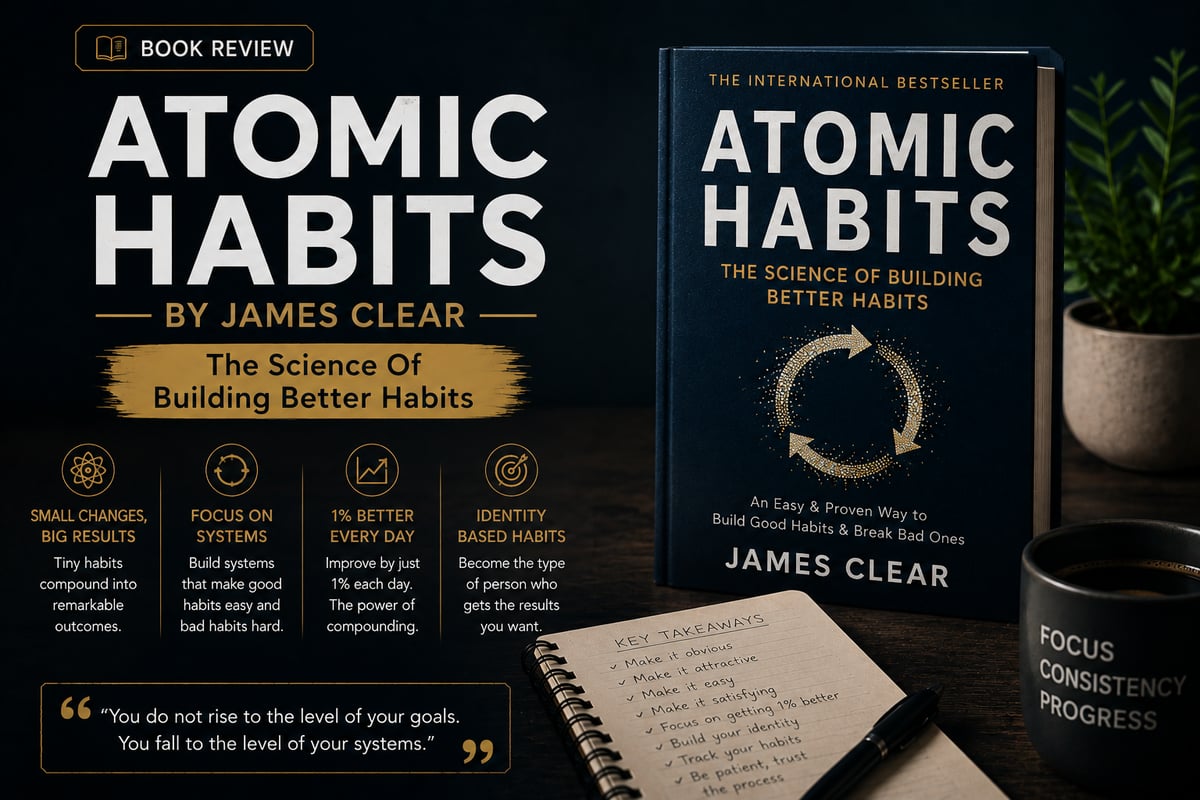
Atomic Habits by James Clear is the definitive guide to building good habits and breaking bad ones. Discover the power of tiny changes that lead to remarkable results.
Atomic Habits by James Clear is the definitive guide to building good habits and breaking bad ones. Discover the power of tiny changes that lead to remarkable results.
Cet article a été écrit par Sarah Jenkins.
Atomic Habits by James Clear is one of the most influential modern books on habits, behavior change, productivity, and personal development. Published in 2018, the book presents a practical argument: remarkable results do not necessarily come from making dramatic changes overnight. Instead, meaningful improvement can emerge from small behaviors repeated consistently over a long period.
The word "atomic" captures two complementary ideas. An atomic habit is very small, but it can also be part of a larger system. A tiny behavior may seem insignificant when viewed in isolation, yet repeated hundreds or thousands of times, it can influence skills, routines, health, relationships, and professional development.
James Clear's approach is particularly appealing because he moves the discussion away from motivation alone. Instead of asking people to rely on extraordinary discipline, he encourages them to redesign their environments, make desirable behaviors easier, reduce friction, and create systems that support repetition.
The book's central message can be summarized simply: small improvements become powerful when they are repeated consistently and supported by the right environment.
One reason for the popularity of Atomic Habits is its practical approach to a problem almost everyone faces: knowing what we should do but struggling to do it consistently.
Most people understand that exercise is beneficial, reading can improve knowledge, saving money can improve financial stability, and focused work can help career development. The difficulty is turning these intentions into behaviors that survive busy schedules, stress, boredom, and distractions.
Clear addresses this gap by focusing on the mechanics of behavior.
Instead of simply telling readers to "be more disciplined," he asks a different question: How can you design your life so that the desired behavior becomes easier to repeat?
That change in perspective is one of the book's greatest strengths.
The fundamental philosophy of the book is that small changes can accumulate.
A single workout will not transform someone's fitness. One healthy meal will not completely change someone's health. Reading ten pages will not immediately make someone an expert.
But repeated behaviors can create a very different result.
The same principle applies to negative habits. One unproductive evening may not seem important, but repeatedly avoiding important work can eventually create significant consequences.
This is why Clear encourages readers to think about the direction of their habits rather than obsessing over immediate results.
One of the most recognizable ideas associated with Atomic Habits is the concept of getting slightly better over time.
The commonly cited illustration is that improving by 1% each day would produce a dramatically larger result over a year because the improvement compounds.
The mathematical idea behind this is important, but it should not be interpreted literally as a guarantee that every human behavior can improve by exactly 1% every day.
Real life is not a perfectly predictable mathematical system.
Progress can be uneven. Some weeks may produce significant improvements, while others may produce almost no visible progress.
The deeper lesson is about compounding: repeated small improvements can create much larger differences over long periods.
One of the frustrating aspects of personal development is that effort and results do not always appear at the same time.
Someone may exercise regularly for several weeks without seeing dramatic physical changes.
A person learning a language may study every day while still struggling to have a conversation.
A writer may publish consistently before receiving significant attention.
A business owner may improve a product repeatedly before customers respond.
This can create the impression that the effort is not working.
Clear describes this general phenomenon as the difficulty of recognizing progress before the results become visible.
The important lesson is that the absence of immediate results does not necessarily mean that the behavior has no value.
Progress often remains invisible for longer than people expect.
Imagine a person saving a small amount of money every month. During the first months, the difference may be difficult to notice.
The same is true for learning, fitness, professional skills, and creative work.
The early stage can feel disappointing because the visible outcome does not yet reflect the accumulated effort.
This is why consistency matters.
A habit can be producing benefits before those benefits become obvious.
One of the most important distinctions in Atomic Habits is between goals and systems.
A goal describes an outcome you want.
A system describes the process you use to move toward that outcome.
For example, "I want to write a book" is a goal.
"Write 500 words every weekday morning" is a system.
"I want to become healthier" is a goal.
"Prepare a healthy lunch before leaving for work" is a system.
Goals provide direction, but systems determine what happens repeatedly.
Motivation is useful, but it fluctuates.
You may feel highly motivated on Monday and exhausted on Thursday.
If your behavior depends entirely on motivation, your routine will become inconsistent.
A well-designed system reduces the amount of motivation required.
If your running shoes are prepared the night before, starting a morning run becomes easier.
If your book is already open on your desk, reading becomes easier.
If distracting applications are blocked during focused work, concentration becomes easier.
The environment does some of the work for you.
Clear organizes his practical framework around four laws:
Make it obvious.
Make it attractive.
Make it easy.
Make it satisfying.
These laws describe four stages of designing a behavior that is easier to repeat.
They can be applied to almost any habit.
If you want to read more, make your book visible, connect reading with something enjoyable, make the first reading session short, and create a satisfying sense of progress.
If you want to reduce an unwanted behavior, reverse the process: make it invisible, unattractive, difficult, and less rewarding.
The first step is increasing awareness.
Many habits happen automatically because they are triggered by familiar circumstances.
A particular room, time of day, emotion, person, or object can become associated with a behavior.
For example, someone may automatically check their phone when they sit at their desk.
Another person may automatically snack when watching television.
Recognizing these cues is important because you cannot redesign a behavior effectively if you do not know what triggers it.
A useful first step is to observe your existing routines without immediately trying to change everything.
What do you do when you wake up?
What happens after breakfast?
When do you check your phone?
When do you usually become distracted?
What situations make you more likely to procrastinate?
This type of observation creates awareness.
You may discover that a habit you thought was random actually follows a predictable pattern.
Once the pattern is visible, it becomes easier to intervene.
Clear also emphasizes the usefulness of specifying when and where a behavior will happen.
Instead of saying, "I should exercise more," create a specific plan.
For example:
"I will exercise for twenty minutes at 7:00 a.m. in my living room on Monday, Wednesday, and Friday."
The exact schedule can vary.
The important principle is specificity.
A vague intention leaves the brain to decide when to act.
A specific plan removes some of that uncertainty.
Another practical technique is habit stacking.
The idea is to connect a new behavior to an existing habit.
For example, you could decide:
"After I brush my teeth, I will read two pages."
The existing habit becomes a cue for the new one.
This works because the established routine already has a place in your day.
Instead of trying to create an entirely new behavioral structure, you attach the new action to something that already happens consistently.
People are more likely to repeat behaviors they find appealing.
This sounds obvious, but it has important implications for habit design.
If a healthy behavior feels extremely unpleasant while an unhealthy behavior is immediately rewarding, relying on willpower alone can be difficult.
Clear suggests finding ways to make desirable habits more attractive.
One method is connecting a necessary behavior with something enjoyable.
Temptation bundling involves pairing an activity you need or want to do with something you enjoy.
For example, you might listen to your favorite podcast only while exercising.
You could listen to music you enjoy while cleaning.
You could reserve a favorite coffee for a focused reading session.
The goal is to create a positive association with the behavior.
Over time, the routine may become easier to anticipate and repeat.
Our social environment can strongly influence our habits.
If everyone around you regularly exercises, studies, reads, or works on creative projects, those behaviors can begin to feel normal.
Conversely, if the people around you constantly engage in behaviors you are trying to reduce, resisting those patterns may become more difficult.
This does not mean you need to abandon friends or completely change your social circle.
It means recognizing that behavior is influenced by context.
The people we spend time with can shape what we consider normal.
The third law focuses on reducing friction.
If a behavior requires ten steps to begin, it is easier to postpone.
If it requires only one or two steps, starting becomes easier.
Suppose you want to exercise in the morning.
Preparing your clothes, shoes, and equipment the night before reduces the number of decisions required when you wake up.
The goal is not to eliminate effort completely.
It is to eliminate unnecessary effort.
Small environmental changes can make a significant difference.
Keep healthy food accessible.
Put your book somewhere visible.
Prepare your workspace before starting.
Keep distracting devices outside the room during deep work.
Save useful resources where they are easy to access.
These changes may appear trivial, but they can influence whether the desired behavior begins.
One of the most memorable concepts in Atomic Habits is the Two-Minute Rule.
The basic idea is to make the beginning of a new habit extremely easy.
Instead of telling yourself, "I will read for thirty minutes every evening," start with "I will read one page."
Instead of "I will run five kilometers," begin with "I will put on my running shoes."
Instead of "I will study for two hours," start with "I will open my textbook and study for two minutes."
The point is not that two minutes are always enough.
The point is to make starting so easy that resistance is reduced.
Starting is often the hardest part.
Once you begin, continuing may require less effort than expected.
This is why reducing the activation energy of a habit can be so effective.
The first goal is not perfection.
The first goal is establishing the behavior of showing up.
Once that behavior becomes automatic, increasing the duration or intensity becomes easier.
The fourth law concerns reinforcement.
Humans tend to repeat behaviors that produce rewarding experiences.
The challenge with many positive habits is that their benefits are delayed.
Exercise may produce long-term health benefits, but the workout itself may feel difficult.
Studying may improve future opportunities, but it can be tiring today.
Saving money can improve long-term financial security, but spending money can feel immediately rewarding.
Creating some form of immediate satisfaction can help bridge this gap.
Many unhealthy behaviors are powerful precisely because they provide immediate rewards.
Scrolling through social media is immediately stimulating.
Eating highly palatable food can produce immediate pleasure.
Buying something can create a short-term emotional boost.
Meanwhile, many desirable behaviors provide delayed benefits.
This creates a behavioral mismatch.
Habit design can help make positive behaviors more immediately satisfying through visible progress, checklists, streaks, or other forms of feedback.
Habit tracking is another useful technique associated with the book.
Tracking provides visual evidence that a behavior has occurred.
A simple calendar can be enough.
Place a mark on each day you complete the desired behavior.
The growing chain can create a sense of progress.
However, tracking should remain a tool rather than becoming the goal itself.
Missing one day should not become a reason to abandon the entire habit.
The objective is behavior change, not a perfect spreadsheet.
One of the most practical ideas is the principle of avoiding repeated lapses.
Missing one workout does not destroy your progress.
Skipping one day of reading does not mean the habit has failed.
The danger comes when one missed day becomes a new pattern.
A useful mindset is:
One mistake is an event. Repeated mistakes can become a habit.
This approach encourages recovery rather than perfectionism.
Perhaps the most influential concept in Atomic Habits is identity-based behavior change.
Clear distinguishes between three levels of change: outcomes, processes, and identity.
Outcome-based thinking focuses on what you want to achieve.
Process-based thinking focuses on what you do.
Identity-based thinking focuses on who you believe you are becoming.
Instead of saying, "I want to read more books," you can think, "I am becoming a reader."
Instead of saying, "I want to exercise," you can think, "I am someone who takes care of my body."
The identity becomes connected to the behavior.
When a behavior becomes part of your identity, consistency can become easier.
A person who sees themselves as a reader may naturally look for opportunities to read.
Someone who identifies as a writer may prioritize writing even when inspiration is absent.
Someone who sees themselves as a disciplined professional may be more likely to follow through on commitments.
The important point is that identity should be built through evidence.
You do not become a runner simply by saying "I am a runner."
You reinforce the identity every time you run.
Small actions become votes for the person you want to become.
Identity-based habits also require flexibility.
Identities can become restrictive if taken too literally.
Someone who thinks "I am not a creative person" may avoid creative opportunities.
Someone who thinks "I am bad at mathematics" may stop practicing.
Someone who identifies exclusively with one profession may struggle when their career changes.
A healthier approach is to treat identity as something that can evolve.
You are not required to remain exactly the same person forever.
One of the strongest themes in the book is environmental design.
People often blame themselves for lacking discipline when the environment is constantly encouraging the unwanted behavior.
If your phone is beside you during focused work, distraction is always available.
If unhealthy snacks are visible on your desk, they become easier to choose.
If your gym clothes are hidden in a closet, exercising requires additional preparation.
Changing the environment can reduce the number of moments in which willpower is required.
A useful question is:
"What can I change around me so the right behavior becomes easier?"
If you want to read, place books where you spend time.
If you want to drink more water, keep a bottle nearby.
If you want to work deeply, remove unnecessary notifications.
If you want to eat more healthily, make nutritious foods convenient.
If you want to practice a skill, keep the required equipment ready.
The environment becomes part of the habit system.
The same principle works in reverse.
If you want to reduce an unwanted behavior, make it more difficult.
Move distracting applications away from the home screen.
Log out of websites you habitually check.
Keep tempting snacks out of immediate reach.
Put your phone in another room during important work.
The goal is not to make the behavior impossible.
A few additional steps can be enough to create a pause between impulse and action.
Habits can be understood as recurring behavioral patterns.
A cue triggers anticipation.
The brain expects a reward.
The behavior takes place.
The reward reinforces the association.
Over time, the sequence can become increasingly automatic.
Understanding this pattern can help explain why certain habits are difficult to change.
You are not simply fighting a single behavior.
You are changing a system of cues, expectations, actions, and rewards.
A behavior becomes more likely when the brain expects a rewarding outcome.
This expectation can create craving.
For example, receiving a notification may create an expectation of social information.
Seeing a restaurant advertisement may create an expectation of pleasure from food.
Opening a gaming application may create an expectation of entertainment.
Understanding the anticipated reward helps explain why certain cues can be so powerful.
Changing the cue or reward structure can therefore help alter the behavior.
Bad habits often provide immediate rewards.
This is why telling yourself to "just stop" may not be enough.
The behavior has likely become associated with specific cues and emotional states.
Stress may trigger scrolling.
Boredom may trigger snacking.
Anxiety may trigger avoidance.
Fatigue may trigger procrastination.
Changing the habit requires understanding what function the behavior serves.
Sometimes the easiest way to reduce an unwanted behavior is to replace it with an alternative.
If you automatically reach for your phone when bored, you might keep a book nearby.
If stress leads to unhealthy snacking, you might create another short stress-management routine.
If procrastination appears whenever a task feels overwhelming, you might reduce the task to a two-minute starting action.
The replacement does not have to be perfect.
It simply needs to provide a more constructive response to the same trigger.
Motivation has a role in behavior change, but Atomic Habits does not treat it as the entire solution.
Motivation rises and falls.
A good system allows behavior to continue even when motivation is low.
This is why preparation and environmental design matter.
If a habit requires a heroic level of motivation every time, it may not be sustainable.
The objective is to create routines that are manageable on ordinary days, not only on highly motivated days.
A common mistake is starting too aggressively.
Someone decides to exercise every day for an hour, completely change their diet, wake up at five in the morning, read fifty pages, and learn a new skill simultaneously.
This can produce impressive results for a few days.
Then exhaustion arrives.
A smaller routine may be less exciting but more sustainable.
Consistency creates repetition.
Repetition creates familiarity.
Familiarity can make the behavior easier.
Habit formation does not require perfection.
People get sick.
Schedules change.
Travel happens.
Unexpected responsibilities appear.
A sustainable system must account for disruption.
The goal is not to create a routine that works only under perfect conditions.
The goal is to create a routine that can survive imperfect conditions.
This may mean having a smaller version of the habit for difficult days.
Suppose you want to read more books.
Start by making the book visible.
Choose a specific time when reading can happen.
Attach it to an existing routine.
Begin with a small number of pages.
Keep your phone away while reading.
Track your progress if that motivates you.
The objective is to make reading a normal part of your day rather than an activity requiring a major decision each time.
For exercise, the same framework applies.
Make the activity obvious by preparing your equipment.
Make it attractive by choosing a form of movement you actually enjoy.
Make it easy by starting with a manageable session.
Make it satisfying by tracking progress or noticing how you feel afterward.
Over time, the routine can become more established.
The most important factor is choosing a realistic starting point.
Students can also apply the four laws.
Keep study materials visible.
Choose a specific time and location.
Start with a small session.
Remove distracting applications.
Break large assignments into smaller tasks.
Track completed sessions.
This approach reduces the psychological difficulty of beginning.
Once studying becomes a regular part of the routine, longer sessions may become easier.
Digital technology creates a special challenge because many applications are specifically designed to maximize engagement.
Notifications, infinite scrolling, recommendations, and variable rewards can encourage repeated checking.
The solution is not necessarily to eliminate technology.
Instead, create boundaries.
Disable unnecessary notifications.
Move distracting applications away from your primary screen.
Use device-free periods.
Keep your phone physically distant during important tasks.
Make focused work the easier default.
The book offers an important alternative to traditional productivity thinking.
Productivity is not simply about doing more.
It is about consistently doing actions that matter.
A person can have a sophisticated productivity system and still spend most of their time on low-value activities.
Habits help determine where attention goes repeatedly.
Building better routines can therefore improve productivity without requiring constant optimization.
Planning, researching, organizing, and preparing can sometimes feel productive.
But they are not always the same as action.
You can spend weeks researching how to start a business without contacting a single potential customer.
You can organize your notes endlessly without writing the report.
You can watch productivity videos without changing your routine.
Clear's framework encourages movement from preparation to behavior.
The system should eventually produce real-world action.
Failure is not necessarily evidence that a habit system does not work.
Sometimes the target is too ambitious.
Sometimes the environment is poorly designed.
Sometimes the cue is unclear.
Sometimes the reward is insufficient.
Sometimes the habit simply does not fit the person's schedule.
Instead of judging yourself immediately, examine the system.
Ask what made the behavior difficult.
Then modify the system.
This creates an experimental mindset.
There is no universal number of days required for every habit to become automatic.
Different behaviors have different levels of complexity, reward, and difficulty.
A simple habit may become familiar relatively quickly.
A complex behavior involving multiple decisions may take much longer.
The important principle is repetition in a stable context.
Rather than asking, "How many days until this becomes automatic?" ask:
"How many opportunities have I had to practice this behavior?"
The four laws can also be used to break unwanted habits.
To make a bad habit less likely:
Make it invisible.
Remove the cue.
Make it unattractive.
Remind yourself of its long-term cost.
Make it difficult.
Increase friction between yourself and the behavior.
Make it unsatisfying.
Reduce the immediate reward or create accountability.
This reversal turns the framework into a tool for both building and reducing habits.
One of the book's greatest strengths is practicality.
The concepts are relatively easy to understand and can be translated into concrete actions.
Another strength is the emphasis on systems rather than motivation.
This helps readers understand why changing an environment can sometimes be more effective than simply trying harder.
The identity-based approach is also memorable because it connects daily actions with a broader sense of personal development.
No habit framework can explain every aspect of human behavior.
People's circumstances differ significantly.
Stress, financial pressure, work schedules, family responsibilities, psychological factors, health, and social environments can all influence behavior.
Small habits are powerful, but they are not a universal solution to every problem.
There is also a risk of becoming overly focused on optimization.
Life is not a productivity experiment.
Some habits should exist simply because they make life enjoyable, meaningful, or connected—not because they maximize measurable output.
The book incorporates ideas that connect with behavioral psychology and research on learning, reinforcement, environmental cues, and behavior change.
However, not every statement in the book should be interpreted as a definitive scientific law.
Clear presents research and concepts in an accessible self-help framework.
Readers should therefore distinguish between research-informed principles and simplified rules designed to make those principles easier to apply.
The book's value is largely practical: it translates complex behavioral ideas into memorable strategies.
Atomic Habits can appeal to a wide range of readers.
Students can use its framework to create study routines.
Professionals can use it to improve focus and skill development.
Entrepreneurs can apply it to sales, product development, and consistent execution.
Readers interested in fitness can use environmental design and habit stacking to support exercise.
People trying to read more, save money, learn languages, write, or reduce digital distractions can also adapt the framework.
Its flexibility is one of its strongest features.
Readers who already have highly developed behavioral systems may find some of the concepts familiar.
People looking for a deep academic treatment of behavioral science may prefer specialized research or university-level texts.
The book is primarily designed to be practical and accessible rather than academically exhaustive.
It should therefore be viewed as an introduction and framework rather than a complete theory of human behavior.
A modern application of the book can begin with one small behavior.
Do not attempt to redesign your entire life at once.
Choose something specific.
Instead of "be healthier," choose "drink a glass of water after waking up."
Instead of "read more," choose "read two pages before sleeping."
Instead of "be more productive," choose "work for ten distraction-free minutes after starting the day."
Once the behavior becomes stable, it can gradually expand.
A simple formula inspired by the book is:
Choose the identity.
Decide who you want to become.
Choose the behavior.
Identify one action that provides evidence for that identity.
Design the cue.
Decide when and where it will happen.
Reduce friction.
Make the behavior easier to start.
Create immediate satisfaction.
Track or reward the behavior in an appropriate way.
Review and adapt.
Change the system when reality shows that something is not working.
Atomic Habits by James Clear is a highly practical book about how small behaviors can influence larger outcomes over time.
Its most valuable contribution is the shift from dramatic transformation to sustainable repetition.
You do not necessarily need to completely reinvent yourself.
You can begin with one behavior.
Make it obvious.
Make it attractive.
Make it easy.
Make it satisfying.
Then repeat.
The book also provides a useful perspective on identity. Instead of focusing exclusively on what you want to achieve, think about the type of person you want your repeated actions to represent.
A person who wants to become a writer writes.
A person who wants to become a reader reads.
A person who wants to become physically active moves regularly.
A person who wants to become more knowledgeable creates opportunities to learn.
The identity is not created by a declaration alone. It is reinforced through repeated evidence.
At the same time, Atomic Habits should not be interpreted as a promise that tiny habits can solve every problem. External circumstances matter, and some challenges require more than individual behavior change. The book is most useful when its principles are combined with realistic expectations, flexibility, and an understanding of one's circumstances.
Ultimately, the enduring lesson of Atomic Habits is that extraordinary change does not always begin with an extraordinary action.
Sometimes it begins with something almost too small to notice.
One page.
One workout.
One focused work session.
One healthy meal.
One difficult conversation.
One decision repeated tomorrow.
Then again the next day.
Over months and years, these small actions can become part of a system, and that system can gradually shape the direction of a life.
That is what makes Atomic Habits by James Clear such an enduring personal development book: it turns the intimidating idea of "changing your life" into a much more manageable question—what small behavior can you repeat today?
The strength of Atomic Habits lies in its practical framework. Rather than telling readers simply to « be more disciplined », James Clear focuses on how behaviors are triggered, repeated and reinforced. This makes the book particularly useful for people who understand what they want to change but struggle to maintain consistent action.
What we find especially valuable is the emphasis on systems and environment. A person who constantly depends on motivation is vulnerable to fluctuations in energy and mood. Designing an environment that makes desirable behaviors easier can reduce this dependence.
However, the book should not be interpreted as proof that every problem can be solved through better habits. Circumstances matter. Financial limitations, work conditions, health, family responsibilities and other external factors can significantly influence behavior. Habits are powerful tools, but they operate within real-life constraints.
Soyez le premier à commenter !