riwaya.
We use cookies to improve your experience, analyze our traffic, and offer you personalized offers. Learn more in our Privacy Policy.
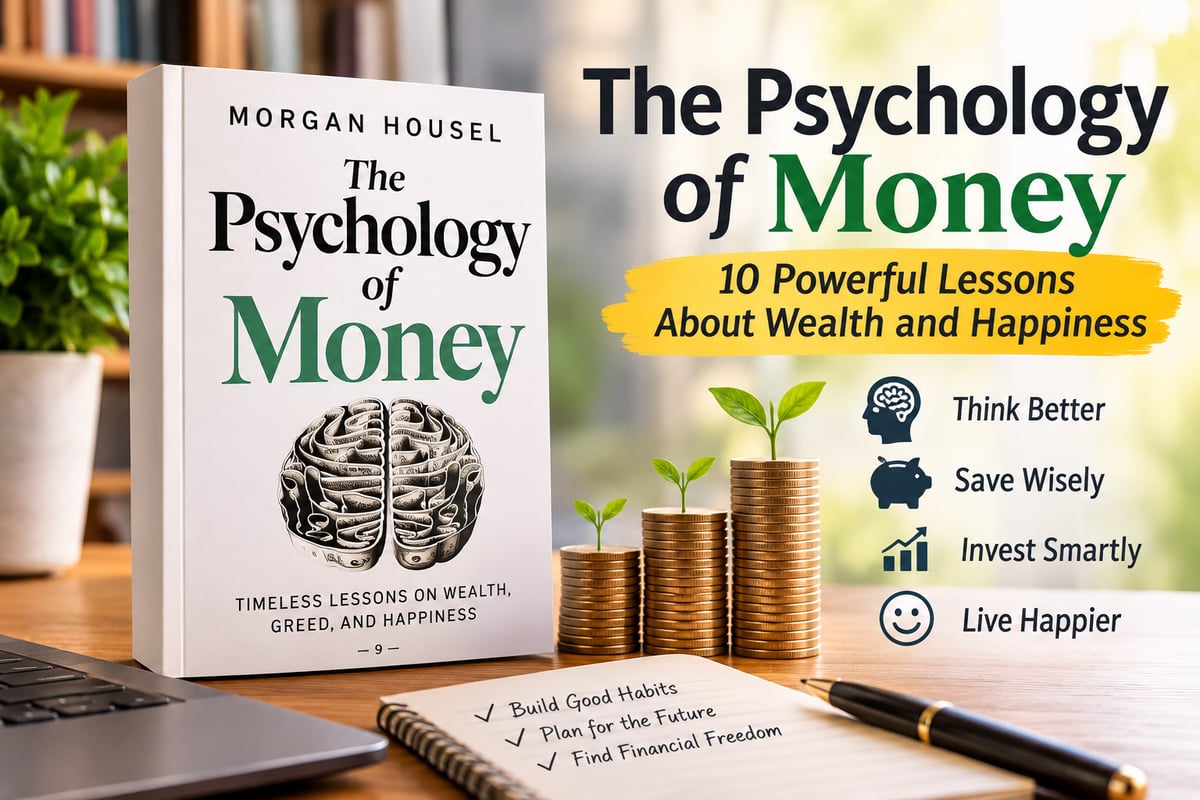
Discover 10 powerful lessons from Morgan Housel’s bestselling book *The Psychology of Money* and learn why financial success is about more than earning money. Explore the psychology behind wealth, saving, investing, happiness, and financial freedom, and discover how small decisions can transform your financial future.
Discover 10 powerful lessons from Morgan Housel’s bestselling book *The Psychology of Money* and learn why financial success is about more than earning money. Explore the psychology behind wealth, saving, investing, happiness, and financial freedom, and discover how small decisions can transform your financial future.
This article was written by Amine hassouni.
Money is one of the most important parts of modern life, yet it is also one of the most misunderstood. People spend years studying mathematics, science, history, and professional skills, but very few receive a proper education about how to manage money, build wealth, or make better financial decisions. As a result, many individuals earn good salaries but struggle to save, while others with modest incomes gradually build financial stability.
Why does this happen? The answer is not always related to intelligence, education, or income. In many situations, the way people think and behave around money has a much greater influence on their financial future than the amount they earn.
In his bestselling book The Psychology of Money, American author Morgan Housel explores the relationship between human behavior and financial success. Rather than presenting complicated investment formulas or promising overnight wealth, Housel explains why emotions, personal experiences, patience, risk tolerance, and everyday decisions shape our financial lives.
The central message of the book is simple but powerful: financial success is not necessarily about knowing everything about money. It is about developing behaviors that allow you to make reasonable decisions consistently over a long period.
Through stories, historical examples, and practical observations, Morgan Housel introduces important ideas that can change how readers understand wealth, happiness, saving, investing, and financial independence.
In this article, we explore ten powerful lessons from The Psychology of Money and examine how they can be applied to everyday life.
One of the most important ideas in The Psychology of Money is that financial success depends heavily on behavior. People often assume that becoming wealthy requires exceptional intelligence, advanced financial knowledge, or access to exclusive investment opportunities. Although knowledge is useful, it does not guarantee good financial decisions.
A person can understand financial markets perfectly and still lose money because of impatience, excessive confidence, fear, or greed. Another individual with limited financial knowledge may gradually build wealth simply by spending less than they earn, avoiding unnecessary debt, and investing consistently.
The difference often comes down to discipline and emotional control.
Imagine two people who earn exactly the same monthly salary. The first person increases their lifestyle whenever their income rises. They purchase expensive products, finance unnecessary purchases, and spend most of their available money. The second person maintains a reasonable lifestyle, saves part of every salary, and avoids making financial decisions based on social pressure.
After several years, their financial situations may look completely different, even though they started with identical incomes.
This illustrates an essential principle: managing money successfully requires habits that can be maintained over time.
Financial discipline does not mean refusing to enjoy life. It means understanding the difference between what you can afford today and what will genuinely improve your life in the long term.
Practical lesson: Develop simple financial habits before searching for complicated investment strategies. Track your spending, build an emergency fund, avoid unnecessary debt, and make saving a regular part of your financial routine.
Another powerful lesson from Morgan Housel is that luck and risk are unavoidable parts of financial life.
People often judge success by looking only at the final result. When someone becomes extremely wealthy, observers may assume that every decision they made was intelligent. When another person loses money, they may conclude that the individual made poor choices.
However, real life is more complicated.
Two people can make almost identical decisions and experience completely different outcomes because of circumstances outside their control. Economic conditions, unexpected events, timing, family situations, technological changes, and market movements can influence results significantly.
This does not mean that preparation and good decisions are useless. Instead, it reminds us that outcomes are never entirely under our control.
Consider two entrepreneurs who launch similar businesses. Both work hard, understand their customers, and develop reasonable business plans. One launches during a period of strong economic growth, while the other faces an unexpected economic crisis. Their results may differ dramatically despite similar levels of effort and competence.
Recognizing the role of luck encourages humility. It also prevents people from believing that every successful strategy will work in every situation.
At the same time, understanding risk encourages caution. A decision that produces a positive result once is not necessarily a good decision. Sometimes, people make dangerous financial choices and simply benefit from favorable circumstances.
The goal should therefore be to build a financial strategy that can survive unexpected difficulties.
Practical lesson: Avoid depending on a single opportunity, investment, customer, or source of income. Build financial protection, diversify when appropriate, and leave room for unexpected events.
Compounding is one of the most important concepts in personal finance. It describes how money can generate returns that themselves generate additional returns.
At first, the effect may appear insignificant. However, over long periods, even relatively modest returns can produce impressive results.
Morgan Housel emphasizes that successful investing is not necessarily about achieving extraordinary returns every year. It is often about allowing reasonable returns to accumulate over a sufficiently long period.
Imagine someone who regularly invests a modest amount every month. During the first few years, their portfolio may not look particularly impressive. However, as time passes, previous investments continue generating potential returns while new contributions increase the total amount invested.
This creates a snowball effect.
For example, suppose an individual invests 1,000 monetary units every month for 30 years and achieves an illustrative average annual return of 7%, compounded monthly. Their contributions total 360,000 monetary units, while the hypothetical final portfolio would be approximately 1.22 million monetary units.
This example is mathematical rather than a promise of investment performance. Actual returns fluctuate, fees and taxes matter, and investments can lose value.
The most important point is that time can become one of the greatest advantages available to an investor.
Starting early gives compounding more opportunities to work. Someone who begins investing with modest amounts at a young age may eventually accumulate more wealth than someone who waits many years before making larger contributions.
Compounding also applies beyond money. Knowledge, professional experience, healthy habits, and strong relationships can produce similar cumulative benefits.
Practical lesson: Focus on consistency instead of trying to predict the perfect investment moment. Start with amounts you can comfortably afford, understand the risks, and give your strategy enough time to develop.
Many people believe that the hardest part of financial success is making money. However, Morgan Housel explains that accumulating wealth and preserving it require different qualities.
Building wealth may involve taking calculated risks, pursuing opportunities, learning new skills, and accepting uncertainty. Preserving wealth requires a different mindset: caution, humility, patience, and the ability to avoid unnecessary financial risks.
A person may become wealthy through a successful business, an investment opportunity, or a high-paying career. But maintaining that wealth over several decades requires avoiding decisions that could destroy years of progress.
For example, someone who experiences rapid financial success might become overconfident. They may invest too much money in one opportunity, borrow excessively, or increase their lifestyle until their expenses become difficult to manage.
If circumstances change, their financial situation can deteriorate quickly.
This is why financial survival matters so much.
A sustainable financial strategy should not depend on everything going perfectly. It should be capable of surviving economic downturns, unexpected expenses, temporary unemployment, and disappointing investment results.
The ability to remain financially stable during difficult periods is often more valuable than achieving exceptional results during favorable periods.
Practical lesson: Protect what you have built. Maintain emergency savings, avoid excessive borrowing, understand your financial commitments, and do not risk your entire future for a potentially impressive short-term reward.
One of the most interesting ideas in The Psychology of Money is the difference between being rich and being wealthy.
Richness is often visible. Expensive cars, luxury watches, designer clothing, large houses, and exclusive holidays can suggest that someone has considerable financial resources.
Wealth, however, is often invisible.
It consists of assets that have not been spent, savings that remain available, investments that continue growing, and financial choices that provide greater freedom in the future.
Someone who purchases an expensive car may appear wealthy, but the purchase itself does not reveal their savings, debts, or financial obligations.
Another person may drive an ordinary vehicle, live in a modest home, and maintain substantial investments. Their lifestyle may attract little attention, but their financial position could be much stronger.
This distinction is important because modern society constantly encourages people to demonstrate their success through consumption.
Social media makes the situation even more complicated. People frequently share photographs of holidays, luxury purchases, restaurants, and expensive experiences without showing the financial reality behind them.
Comparing your financial life with these images can create unnecessary pressure.
True wealth is not necessarily about impressing other people. It is about having resources that allow you to make decisions without constantly worrying about money.
Practical lesson: Measure your financial progress through savings, assets, reduced debt, and increased financial independence rather than through the appearance of your lifestyle.
Saving is often presented as a way to prepare for future purchases. However, Morgan Housel suggests that its greatest value may be the freedom it provides.
Money saved today can create options tomorrow.
It can help someone leave an unhealthy working environment, handle an unexpected medical or household expense, change careers, start a business, or take time to reconsider an important decision.
Without savings, even small unexpected events can become major financial problems.
Consider two employees working in similar positions. Both receive the same salary and have similar responsibilities. One spends nearly all their income every month, while the other consistently saves a portion.
If both experience an unexpected job interruption, the second employee has more time to evaluate their options and find another opportunity.
Savings create breathing room.
An emergency fund is particularly useful because it separates unexpected expenses from everyday spending. Instead of relying immediately on credit cards or expensive borrowing, individuals can use money they have already set aside.
The amount required depends on personal circumstances, including income stability, household responsibilities, living costs, and existing financial commitments.
For many people, building an emergency fund covering three to six months of essential expenses is a reasonable starting objective. However, some situations require a larger reserve.
Saving also helps reduce financial anxiety. Knowing that you have resources available can make it easier to approach professional and personal decisions calmly.
Practical lesson: Start by saving a manageable percentage of your income. Automate transfers when possible and gradually build a reserve that reflects your actual financial responsibilities.
People often associate wealth with the ability to purchase expensive products. However, one of the most valuable things money can provide is control over your time.
Financial independence does not necessarily mean retiring early or never working again. It means having more flexibility in deciding how to spend your time and energy.
For example, someone with sufficient savings may have the freedom to refuse an opportunity that conflicts with their values. They may choose to spend more time with their family, learn a new skill, explore a business idea, or work fewer hours.
Someone who depends entirely on their next salary may have fewer choices.
This is why financial freedom can be more meaningful than simply increasing income.
A higher salary is useful, but if every increase leads to higher expenses and additional financial commitments, the individual may not experience any real improvement in their freedom.
The relationship between income, spending, and lifestyle is therefore essential.
Financial independence is not a single destination. It can develop gradually as savings increase, debts decrease, and recurring expenses become easier to manage.
Even a modest financial reserve can provide a meaningful improvement in personal flexibility.
Practical lesson: Before pursuing a more expensive lifestyle, ask yourself whether a financial decision will increase your freedom or create another obligation that limits your choices.
Comparison is one of the most common sources of financial dissatisfaction.
People naturally observe what others own, where they travel, what they earn, and how quickly they progress professionally. However, financial situations are deeply personal.
Two individuals may have different family responsibilities, opportunities, education, financial support, living expenses, and personal priorities.
Comparing their financial results without understanding these differences can lead to poor decisions.
For instance, someone might purchase an expensive smartphone simply because their colleagues have similar devices. Another person might borrow money to finance a luxury holiday because they feel pressured to maintain a certain lifestyle.
These decisions may create short-term satisfaction but can produce long-term financial stress.
Social comparison can also encourage unnecessary investment risks. People may enter financial markets because friends are making money, without understanding the products they are purchasing.
Morgan Housel's broader message is that every person has their own financial goals and circumstances.
There is no universal definition of success.
For one person, financial success may mean owning a business. For another, it may mean buying a comfortable home, supporting family members, or having enough savings to work less.
Understanding your own priorities is essential because it allows you to make decisions based on your actual needs rather than external expectations.
Practical lesson: Define your personal financial objectives. Compare your current situation with your previous situation, not with someone else's lifestyle.
Traditional financial discussions often focus on optimization. People search for the highest possible return, the lowest possible expenses, and the mathematically perfect strategy.
However, Morgan Housel emphasizes the importance of choosing financial strategies that people can realistically maintain.
A theoretically excellent strategy may fail if it creates too much stress or requires a level of discipline that is difficult to sustain.
For example, someone might decide to invest nearly all their available money because they want to maximize long-term returns. But if they have no emergency savings, an unexpected expense could force them to sell investments at an unfavorable moment.
A more balanced approach might produce a lower theoretical return but offer greater financial stability.
The same principle applies to budgeting.
A budget that allows no room for enjoyment may become frustrating. After several weeks, the individual may abandon it completely.
A reasonable budget should support essential expenses, savings, financial goals, and some personal enjoyment.
The objective is not to make every financial decision perfect. It is to build a system that helps you make consistently good decisions.
Personal finance is not simply a mathematical exercise. It is a behavioral discipline influenced by emotions, habits, family circumstances, and personal preferences.
Practical lesson: Choose a financial strategy that fits your real life. A sustainable plan followed for ten years is generally more useful than a perfect plan abandoned after two months.
Perhaps one of the most meaningful lessons in The Psychology of Money is the importance of understanding when you have enough.
Ambition can be positive. It encourages people to learn, improve their professional skills, develop businesses, and pursue meaningful goals.
However, unlimited ambition without clear personal boundaries can become dangerous.
Some individuals continue taking unnecessary risks even after achieving a comfortable financial position. They pursue additional money not because they need it, but because they want to outperform others or maintain a particular image.
This behavior can put years of progress at risk.
The concept of enough does not mean abandoning ambition or refusing to improve your situation. It means recognizing the difference between pursuing meaningful objectives and constantly chasing more without understanding why.
For example, a person who already has stable income, manageable expenses, savings, and a comfortable lifestyle may decide that spending more time with family is more valuable than pursuing another promotion.
Another person may continue developing a business because entrepreneurship is genuinely important to them.
Both decisions can be reasonable.
The key is understanding what money is supposed to accomplish in your life.
Without a clear definition of enough, financial success can become an endless competition.
Practical lesson: Identify what financial security means to you. Establish realistic goals and remember that protecting your well-being is more important than winning a competition that has no finish line.
Understanding financial concepts is useful, but applying them consistently is what creates meaningful progress.
The ideas presented by Morgan Housel can be transformed into a practical personal finance routine.
Start by examining your current financial situation. Calculate your monthly income, essential expenses, outstanding debts, and available savings. This creates a realistic picture of where you stand.
Next, identify your most important financial objective. It might be building an emergency fund, paying off expensive debt, saving for a home, investing for retirement, or developing an additional source of income.
Avoid trying to accomplish everything simultaneously. Prioritize the objectives that will have the greatest impact on your financial stability.
A simple monthly system could include:
Another important habit is to create a waiting period before making expensive non-essential purchases. Waiting 24 or 48 hours can help distinguish genuine needs from temporary impulses.
It is also useful to discuss financial decisions with trusted people who understand your circumstances. A different perspective can reveal risks that may be difficult to notice when emotions are involved.
Finally, remember that financial progress is not always linear. Some months will be more expensive than others. Unexpected events may temporarily reduce your savings. What matters is maintaining a realistic direction rather than expecting every month to be perfect.
Many financial books concentrate on investment strategies, business opportunities, budgeting methods, and wealth-building techniques.
The Psychology of Money approaches the subject from a different perspective.
Morgan Housel focuses on the human side of financial decisions. He explains why individuals behave differently around money, why financial mistakes often result from emotional reactions, and why patience can be more valuable than complicated strategies.
The book also avoids presenting wealth as a guaranteed result of following a specific formula.
Instead, it encourages readers to think critically about their personal circumstances and recognize the importance of uncertainty.
Its strength lies in its accessible storytelling. Rather than relying exclusively on technical explanations, Housel uses examples and observations to demonstrate how financial behavior influences real outcomes.
This makes the book particularly interesting for beginners who want to develop a healthier relationship with money.
However, it can also provide useful perspectives for experienced investors and entrepreneurs who want to reconsider their financial habits.
Readers should understand that the book is not a substitute for professional financial advice. It introduces behavioral principles and general observations rather than providing personalized investment recommendations.
Its greatest contribution may be helping readers ask better questions about what they want money to achieve.
The Psychology of Money can be valuable for people at different stages of their financial lives.
Students and young professionals may benefit from its explanations of saving, patience, and long-term thinking. Developing good financial habits early can make future decisions easier.
Employees who receive a regular salary may discover ways to improve their relationship with spending, savings, and lifestyle inflation.
Entrepreneurs can find useful ideas about risk management, financial resilience, and the importance of maintaining sufficient cash reserves.
Investors may appreciate the book's emphasis on emotional discipline and the difficulty of predicting future market conditions.
Even readers who are not particularly interested in investing can benefit from its broader message: money should serve personal well-being rather than become a permanent source of stress.
It is especially suitable for anyone who has ever wondered why earning more money does not automatically lead to greater happiness or financial security.
For readers interested in personal finance, behavioral psychology, and long-term financial planning, The Psychology of Money is a worthwhile addition to their reading list.
Its greatest strength is that it changes the questions readers ask about money.
Instead of focusing exclusively on how to become rich, it encourages people to consider how to remain financially stable, avoid unnecessary risks, and use money to create a more meaningful life.
The book does not promise instant success. It does not suggest that everyone can become wealthy by following ten simple steps.
Instead, it presents a realistic perspective on financial behavior and reminds readers that good decisions must account for uncertainty, personal circumstances, and human emotions.
The lessons about compounding, saving, patience, risk, and financial independence are particularly valuable because they remain relevant across different economic environments.
Ultimately, the book encourages a healthier definition of wealth: having enough resources, flexibility, and security to live according to your priorities.
The most important message of The Psychology of Money is that financial success is not simply a question of how much money someone earns or owns.
It is also a question of how they think, behave, make decisions, and respond to uncertainty.
Building wealth requires patience. Preserving it requires humility. Saving creates flexibility. Compounding rewards consistency. Understanding personal priorities helps prevent unnecessary financial competition.
Perhaps the greatest lesson is that money should improve your life, not control it.
A financially successful person is not necessarily the individual with the most expensive possessions. It may be someone who has enough savings to handle unexpected events, enough freedom to make independent decisions, and enough confidence to enjoy life without constantly comparing themselves with others.
Morgan Housel's book reminds us that financial knowledge becomes truly valuable when it leads to better everyday decisions.
If you want to understand your relationship with money and develop a more thoughtful approach to wealth, The Psychology of Money is an excellent book to explore.
The Psychology of Money was written by Morgan Housel, an American financial writer and investor known for explaining economic and financial concepts through accessible stories and behavioral observations.
The central message is that financial success depends heavily on human behavior. Patience, discipline, saving, emotional control, and long-term thinking can be just as important as technical financial knowledge.
The book is organized into 20 chapters, each exploring a different idea about money, wealth, risk, behavior, and financial decision-making. The ten lessons discussed in this article are a selection of its most useful themes.
Yes. The book uses accessible language and practical examples, making it suitable for readers who are discovering personal finance for the first time. It does not require advanced knowledge of investing or economics.
The book does not provide a guaranteed formula for becoming rich. Instead, it explains behaviors and principles that can help readers make more thoughtful financial decisions and build greater financial stability over time.
Being rich is often associated with visible income and spending. Being wealthy is more closely related to accumulated assets, financial reserves, and the ability to maintain financial independence.
The book has been published in several languages, including French and Arabic editions. Readers can look for the edition that best matches their reading preferences.
Readers who enjoy this book may also appreciate Atomic Habits by James Clear, Rich Dad Poor Dad by Robert Kiyosaki, The Richest Man in Babylon by George S. Clason, and Think and Grow Rich by Napoleon Hill. These books explore habits, personal finance, wealth-building principles, and the relationship between mindset and success.
Books can change the way we understand the world, but some books also change the way we understand ourselves.
The Psychology of Money is an interesting choice for anyone who wants to develop better financial habits, understand the psychology behind spending, and discover why long-term thinking matters.
If you are building your personal library or looking for your next book about personal development and financial education, explore the selection available on Riwaya.store.
Discover new books, explore different ideas, and take another step toward becoming a more informed reader.
Be the first to comment!
