رواية.
نحن نستخدم ملفات تعريف الارتباط لتحسين تجربتك، وتحليل حركة المرور لدينا، وتقديم عروض مخصصة لك. اكتشف المزيد في سياسة الخصوصية الخاصة بنا.
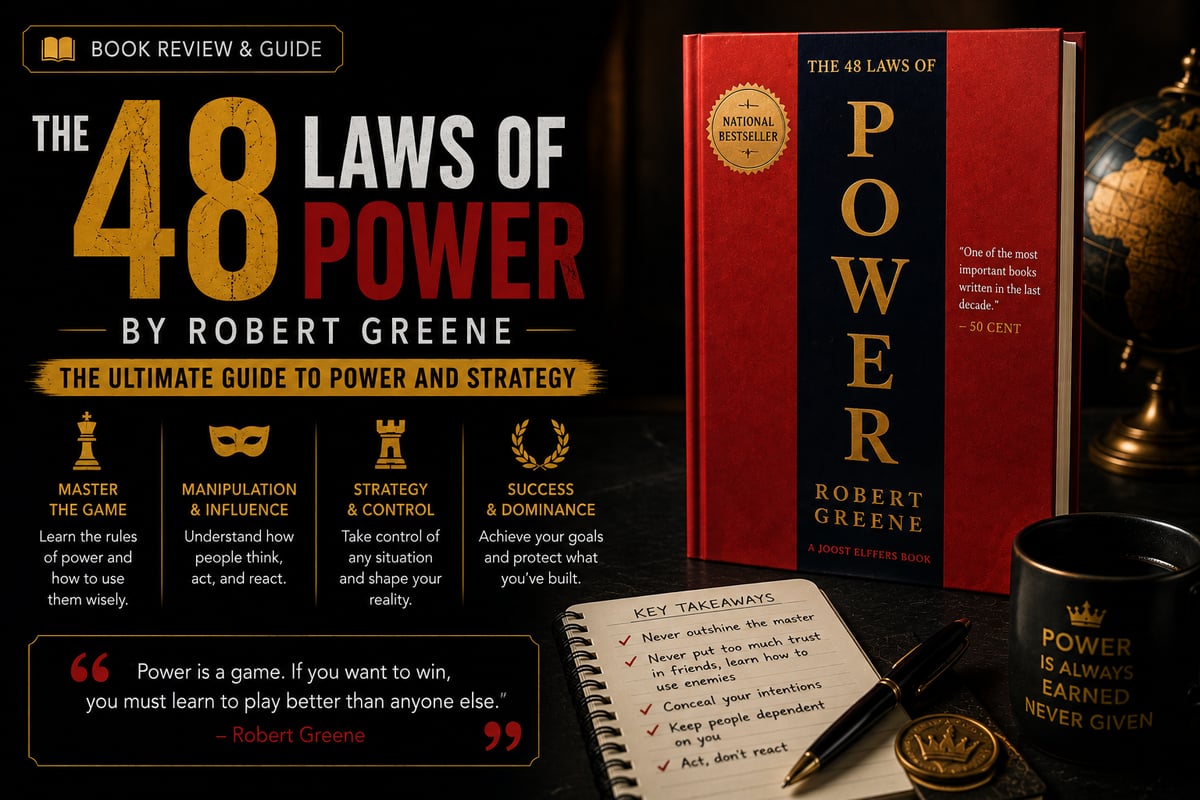

Robert Greene
The 48 Laws of Power by Robert Greene is a provocative and insightful exploration of power dynamics throughout history. A must-read for anyone navigating competitive environments.
كاتب هذا المقال هو Sarah Jenkins.
The 48 Laws of Power by Robert Greene is a provocative and insightful exploration of power dynamics throughout history. A must-read for anyone navigating competitive environments.

The 48 Laws of Power by Robert Greene is one of the most controversial and influential books about power, ambition, strategy, influence, and human behavior. First published in 1998, the book presents 48 principles inspired by historical events, political figures, military leaders, artists, court strategists, and other influential personalities.
Rather than presenting power as something that exists only in politics or large organizations, Robert Greene examines the subtle dynamics that appear whenever people compete for influence, recognition, resources, status, or authority. Offices, businesses, social groups, creative industries, institutions, and even personal relationships can contain complex power dynamics.
The book's appeal comes partly from its historical approach. Instead of relying entirely on modern theories, Greene draws lessons from centuries of political maneuvering, military conflicts, royal courts, diplomacy, deception, ambition, and social competition.
At the same time, The 48 Laws of Power is not a conventional self-help book. Some of its laws describe manipulation, strategic concealment, revenge, reputation management, and ruthless competition. For that reason, the book is best read critically. Understanding a strategy does not mean that a reader should automatically use it.
Its greatest value can be found in learning to recognize how influence works, how people respond to status and incentives, and how seemingly harmless decisions can affect relationships and reputation over time.
كتب مختارة بعناية لتناسب جميع الأذواق وبأفضل الأسعار.
Robert Greene's book is structured around 48 separate laws. Each law is presented as a principle concerning power and accompanied by historical examples intended to demonstrate how the principle has operated throughout history.
The laws cover a wide range of subjects, including reputation, communication, timing, ambition, competition, attention, persuasion, adaptability, and strategic thinking.
Some principles are relatively easy to apply ethically. For example, protecting your reputation, understanding your audience, avoiding unnecessary arguments, and choosing the right moment to act can be useful in ordinary professional situations.
Other laws are much more aggressive and should be approached as descriptions of historical power behavior rather than universal instructions for everyday life.
This distinction is important because the book deliberately presents a darker view of human interaction. Greene is interested in what people sometimes do when their interests conflict, rather than only in how people ideally should behave.
That makes the book fascinating, but it also makes critical thinking essential.
Robert Greene is an American author known for writing about strategy, power, human behavior, mastery, and social dynamics.
Before becoming widely known for his books, Greene developed an interest in history and the patterns of human behavior that repeat across different periods and cultures.
His writing style combines historical anecdotes with concise principles. Instead of building a traditional academic argument around one theory, he frequently uses stories involving famous historical figures to illustrate recurring behavioral patterns.
This storytelling approach is one of the reasons his books have reached audiences far beyond traditional history readers.
Greene has also written other influential books, including The Art of Seduction, Mastery, The Laws of Human Nature, and The Daily Laws.
The popularity of The 48 Laws of Power can partly be explained by its subject.
Power is present in almost every organization, but it is not always discussed openly. Companies have formal hierarchies, yet informal influence can be just as important. Political institutions have official structures, yet relationships and alliances often influence decisions. Creative industries reward talent, but visibility and reputation can also affect opportunities.
Greene gives readers vocabulary for thinking about these dynamics.
The book also appeals to people who are interested in historical strategy. Its examples move across different periods and civilizations, allowing readers to compare how individuals responded to competition and uncertainty.
Another factor is its provocative tone. Many of the laws are intentionally phrased in a dramatic way. This makes them memorable, but it can also encourage readers to interpret them too literally.
The best way to approach the book is therefore not as a collection of commandments, but as a collection of observations and strategic hypotheses that deserve examination.
The first law argues that people should avoid making those above them feel insecure or threatened.
In practical terms, the principle is about understanding status and ego. A talented employee may technically outperform a manager in certain areas, but publicly humiliating or constantly challenging that manager can create resistance.
The deeper lesson is not that you should hide your abilities. Rather, it is that competence must be combined with social intelligence.
In professional environments, people rarely evaluate performance based solely on objective results. They also consider trust, communication, loyalty, collaboration, and whether someone makes them feel respected.
A useful modern interpretation is to demonstrate competence without unnecessarily turning every achievement into a competition.
Greene challenges the assumption that friendship automatically produces better professional relationships.
Friends may sometimes feel entitled to special treatment, while former rivals may have stronger incentives to demonstrate their reliability after a relationship changes.
This law is deliberately provocative, but its broader lesson concerns incentives.
When evaluating whether someone is trustworthy, it can be useful to look beyond personal feelings and examine behavior, incentives, consistency, and past actions.
Trust should not be based solely on friendship or hostility.
The third law concerns strategic communication and the tendency to reveal plans too early.
In competitive situations, sharing every intention can give other people information they may use against you. Businesses, negotiations, career decisions, and competitive projects sometimes require discretion.
However, there is an important difference between discretion and dishonesty.
You do not need to reveal every private thought to everyone, but deliberately misleading people can damage relationships and reputation.
A constructive interpretation of this law is to think before announcing plans. Sometimes it is better to complete the necessary preparation before publicly discussing your intentions.
Greene argues that excessive communication can reduce perceived authority and create opportunities for misunderstanding.
The principle has a practical side. People often weaken their own arguments by continuing to speak after they have already made their point.
Concise communication can demonstrate confidence because it suggests that you do not need to fill every silence.
However, saying less should not become an excuse for poor communication. Complex situations sometimes require detailed explanations.
The real lesson is to make communication intentional. Say what is necessary, avoid unnecessary disclosure, and know when to stop talking.
Reputation is one of the book's most relevant concepts.
A reputation influences how people interpret your actions before they have all the information. Someone known for reliability may receive the benefit of the doubt. Someone known for dishonesty may struggle to regain trust even when telling the truth.
In professional life, reputation can influence hiring, partnerships, promotions, referrals, and business opportunities.
The lesson is therefore highly practical: reputation takes time to build but can be damaged quickly.
Protecting your reputation does not mean obsessing over what everyone thinks. It means consistently behaving in a way that supports the qualities you want others to associate with you.
Greene argues that invisibility can be a disadvantage when influence depends on recognition.
The principle is particularly relevant in modern digital environments. A talented professional may remain unknown if nobody knows what they do.
However, attention alone is not enough. Being visible for the wrong reasons can damage credibility.
A better modern interpretation is to become intentionally visible by creating useful work, communicating your expertise, contributing to discussions, and developing a recognizable professional identity.
The goal should not simply be attention.
The goal should be valuable attention.
This is one of the book's most ethically controversial laws.
Taken literally, it can encourage exploitation and unfair attribution. In a healthy professional environment, taking credit for someone else's contribution can destroy trust.
A more constructive interpretation is the importance of delegation and leverage.
Effective leaders rarely accomplish everything personally. They coordinate teams, use specialized expertise, build systems, and distribute responsibilities.
The ethical distinction is crucial: delegation means giving people appropriate recognition for their contributions, while exploitation means taking credit while denying them recognition.
This law emphasizes creating conditions in which others have an incentive to approach you.
In business, this can relate to positioning. A company that clearly communicates unique value may attract customers instead of constantly chasing them.
In professional life, a strong portfolio, useful expertise, and a good reputation can make opportunities come toward you.
The principle therefore connects power with perceived value.
When people believe that interacting with you provides something meaningful, you gain more negotiating leverage.
Arguments rarely change minds as effectively as evidence.
A person can spend hours explaining why an idea should work, but demonstrating the result can be much more persuasive.
This principle is particularly relevant in professional environments.
Instead of repeatedly arguing that a project can succeed, build a prototype. Instead of insisting that a process is inefficient, measure the time it consumes. Instead of claiming that a marketing strategy works, analyze the results.
Evidence can often accomplish what argument cannot.
Greene argues that emotional states and destructive patterns can spread between people.
The principle should not be interpreted as blaming people for misfortune or suggesting that anyone experiencing difficulties should be abandoned.
A healthier interpretation concerns behavioral patterns.
Constant negativity, destructive habits, chronic conflict, and refusal to take responsibility can affect the people around them.
Personal growth therefore involves choosing your environment carefully while maintaining empathy toward people experiencing genuine difficulties.
This law examines the power created when other people rely on your unique skills or resources.
In a professional context, specialized expertise can create bargaining power. However, deliberately making colleagues dependent by withholding information can create an unhealthy workplace.
A better interpretation is to develop genuine expertise.
If your skills are difficult to replace because they provide real value, you naturally gain influence.
The strongest form of professional leverage comes from being useful, not from deliberately creating dysfunction.
This law explores how unexpected generosity can lower people's defenses.
From an ethical perspective, it is useful to understand the psychological mechanism without treating people as targets.
Unexpected kindness can indeed build trust, but manipulating someone through fake generosity is likely to damage that trust once discovered.
The broader lesson is that people respond strongly to signals of goodwill. Authentic generosity can therefore be a powerful foundation for relationships.
People are often more responsive when they understand how a request connects to their own goals.
This does not necessarily mean manipulating them. It means communicating mutual benefit clearly.
For example, instead of saying, "Please help me with this project," you might explain how collaboration could help both people achieve an important objective.
Effective negotiation frequently depends on identifying shared interests.
This is another law that should be interpreted carefully.
The underlying principle concerns observation and information gathering. Effective decision-makers need accurate information before making important choices.
In legitimate professional settings, this means conducting research, listening carefully, asking questions, and understanding stakeholders.
It does not require deception.
Good strategy often begins with better information.
This is among Greene's most aggressive laws.
Historically, the principle reflects situations in which leaving a powerful rival capable of retaliation could create future conflict.
In ordinary modern life, however, applying this literally would be destructive.
A more constructive lesson is to resolve serious conflicts properly rather than allowing unresolved problems to repeatedly return.
When a dispute is unavoidable, aim for a stable resolution rather than a temporary compromise that leaves the underlying issue untouched.
Scarcity can increase perceived value.
If someone is constantly available, their presence may become taken for granted. Creating healthy boundaries can therefore increase appreciation.
This does not mean deliberately ignoring people or playing emotional games.
It can simply mean recognizing that availability should have limits.
Professionals who protect their time often become more effective because others learn that their attention has value.
Unpredictability can make other people uncertain about how you will respond.
However, excessive unpredictability can destroy trust.
In modern leadership, consistency is often more valuable than fear.
The useful lesson is to avoid becoming completely predictable in competitive environments while maintaining clear principles and reliable standards.
Strategic flexibility is different from chaotic behavior.
Isolation can create vulnerability.
A person who completely withdraws from others may believe they are protecting themselves, but they can lose access to information, relationships, opportunities, and support.
Strong networks provide resilience.
Personal growth therefore involves learning how to establish boundaries without cutting yourself off from the people and communities that can contribute positively to your life.
Not everyone responds to criticism, competition, humor, authority, or negotiation in the same way.
Understanding personality and context can therefore prevent unnecessary conflict.
The principle encourages careful observation before taking action.
A strategy that works with one person may fail completely with another.
Greene emphasizes maintaining strategic independence.
In real life, however, relationships require commitment. Trust cannot be built if someone constantly refuses to take a position.
A balanced interpretation is to avoid becoming unnecessarily dependent on one person, organization, or alliance.
Maintaining options can be useful, especially in uncertain environments.
This law examines the strategic use of appearing less knowledgeable than you are.
While deception can be ethically problematic, there is a useful lesson in not feeling obligated to demonstrate intelligence constantly.
You do not need to prove that you are the smartest person in every conversation.
Sometimes listening carefully is more valuable than displaying expertise.
Surrender can sometimes be strategic rather than purely defeatist.
Continuing a losing battle simply to protect pride can create unnecessary damage.
Recognizing when to retreat can preserve resources for a better opportunity.
The broader lesson is that changing strategy is not necessarily failure.
Scattered attention reduces effectiveness.
Whether you are studying, building a business, developing a career, or working on a creative project, concentrating resources can create stronger results.
This principle closely connects with modern ideas about focus.
Instead of constantly starting new projects, identify the opportunity with the highest potential and invest meaningful effort there.
The "courtier" represents someone who understands social intelligence, diplomacy, and etiquette.
Modern professional environments also require these abilities.
Technical competence matters, but so do communication, emotional intelligence, timing, respect, and the ability to navigate disagreements.
People who understand both the work and the social environment often become more effective leaders.
Greene encourages readers to avoid being trapped by an identity imposed by others.
Personal identity can evolve.
A person who was once shy can become a confident communicator. Someone who struggled academically can develop strong learning habits. A professional can change industries and acquire new skills.
Personal growth often requires deliberately deciding who you want to become rather than simply accepting an identity created by your past.
This law focuses on maintaining a reputation of responsibility and competence.
Leaders often need to create systems that reduce unnecessary association with mistakes.
In modern organizations, the ethical version is clear accountability.
Good leaders do not simply blame others. They build processes that reduce errors, clarify responsibility, and address problems honestly.
Humans naturally search for meaning, community, and certainty.
This can create opportunities for charismatic leaders, brands, communities, and movements.
The ethical lesson is to recognize how narratives influence people.
Whenever someone offers an extremely simple explanation for a complicated world, it is worth asking what evidence supports it and what incentives might be involved.
Hesitation can create uncertainty.
Once a decision has been made, excessive doubt can undermine execution.
Boldness does not mean acting recklessly. It means committing resources and attention after evaluating the risks.
Confidence is often most valuable when combined with preparation.
Strategic thinking requires considering consequences beyond the immediate objective.
A decision that appears successful today may create problems six months later.
Before taking significant action, consider possible outcomes, secondary effects, and what you will do if circumstances change.
This principle is highly useful in business and project management.
People often admire results more when they appear natural.
However, this principle can also encourage people to hide the work required to achieve something.
A healthier interpretation is to develop competence to the point where execution becomes smoother.
Mastery often looks simple from the outside because years of practice have made complex actions more automatic.
The person who defines the available options can influence the final decision.
In negotiations, framing choices can therefore be powerful.
But this principle also highlights the importance of recognizing when someone else has artificially limited your choices.
Good decision-makers ask whether the available options are genuinely exhaustive.
People are influenced by aspirations, emotions, and narratives, not only facts.
Marketing provides a clear example. Successful brands often sell an identity or experience rather than merely a physical product.
Understanding aspirations can improve communication.
However, exploiting unrealistic expectations can become unethical. Good communication should connect with people's aspirations without intentionally deceiving them.
People have different motivations, fears, ambitions, and sensitivities.
Understanding these differences can improve negotiation and communication.
The ethical approach is to use this knowledge to communicate effectively rather than exploit vulnerabilities.
Empathy requires understanding what matters to another person without weaponizing that information against them.
The principle emphasizes self-respect and confidence.
People often respond to the way you present yourself.
Confidence can influence how others interpret your competence, even before they have evaluated your work.
However, confidence should not become arrogance.
The strongest version of this law is to develop self-respect while treating others with respect as well.
Timing can determine whether a good idea succeeds or fails.
The right decision at the wrong moment can produce poor results.
Successful negotiation, product launches, career changes, difficult conversations, and major decisions all require awareness of circumstances.
Strategic patience is therefore an important skill.
Obsessing over unavailable opportunities can waste enormous amounts of attention.
Sometimes the healthiest response to rejection is to redirect your energy.
This does not mean pretending that disappointment does not exist.
It means refusing to let something outside your control dominate your future.
People remember vivid experiences.
Presentations, branding, storytelling, visual communication, and memorable demonstrations can make information more powerful.
The modern version of this law is especially relevant to marketing and content creation.
Good ideas become more effective when communicated in ways people can understand and remember.
People naturally resist ideas that threaten their identity or social group.
This law emphasizes the importance of understanding cultural and social norms.
It does not mean abandoning your values.
Rather, it suggests that effective communication requires adapting how you express ideas according to the audience.
You can maintain your principles while communicating them intelligently.
Conflict can sometimes reveal information.
When people become emotional, they may reveal priorities or weaknesses that were previously hidden.
However, deliberately provoking conflict can cause serious damage.
A more constructive lesson is to remain calm when others become emotional and avoid allowing their reactions to dictate your own behavior.
Free offers are not always free in practice.
There may be hidden conditions, expectations, opportunity costs, or future obligations.
The principle encourages readers to consider the true cost of apparently free resources.
At the same time, not every free resource is suspicious. Education, open-source software, public services, and genuinely generous acts can create enormous value without hidden manipulation.
Critical evaluation is more useful than automatic distrust.
Following a highly successful predecessor can create unrealistic comparisons.
Instead of trying to become a copy of someone else, develop your own strengths and identity.
This is particularly important for people entering leadership roles after respected founders, managers, parents, mentors, or public figures.
Your job is not necessarily to reproduce someone else's success.
Your challenge is to create your own.
This law concerns centralized influence.
Groups often depend heavily on a small number of influential individuals.
Understanding this dynamic can help organizations identify key decision-makers and potential points of failure.
Again, the ethical lesson is analytical rather than destructive: understand where influence is concentrated.
Influence becomes more durable when people genuinely trust and respect you.
Coercion may produce short-term compliance, but relationships based on trust can create stronger cooperation.
Leaders who understand people's motivations can communicate in ways that make others feel heard.
This is one of the most constructive principles in the book when interpreted through emotional intelligence.
Mirroring can reveal patterns in communication.
In psychology and negotiation, carefully reflecting another person's words or behavior can sometimes demonstrate understanding and encourage self-awareness.
However, deliberately provoking someone is unlikely to produce healthy long-term relationships.
The useful lesson is to recognize behavioral patterns without automatically copying destructive behavior.
People often resist sudden changes, even when the changes are objectively beneficial.
Successful organizational transformation therefore requires communication, gradual implementation, and attention to human psychology.
The same principle applies to personal growth.
Trying to transform every aspect of your life simultaneously can create resistance and exhaustion.
Sustainable change is usually incremental.
Perfection can create distance.
People may become uncomfortable around someone who appears completely flawless because the comparison can make them feel inadequate.
Authenticity often creates stronger connections than a carefully manufactured image of perfection.
In modern social media culture, this lesson is particularly relevant. Constantly presenting an idealized life can create unrealistic expectations for both the creator and the audience.
Success can create its own danger.
After achieving an objective, people sometimes continue taking risks because they want an even greater victory.
Knowing when to stop protects gains.
This principle applies to negotiations, investments, business expansion, competition, and personal ambition.
The ability to walk away can be just as important as the ability to pursue.
The final law encourages adaptability.
Rigid strategies can become ineffective when circumstances change.
A person who insists on following one method regardless of context becomes predictable and vulnerable.
Adaptability does not mean having no principles. It means maintaining core values while remaining flexible about tactics.
In a rapidly changing world, this may be one of the book's most relevant ideas.
Although the 48 laws are diverse, several themes appear repeatedly.
The first is awareness. Power often operates through incentives, perceptions, relationships, and informal structures rather than explicit rules.
The second is reputation. What people believe about you can influence how they interpret your behavior and whether they trust you.
The third is timing. Even a strong strategy can fail if implemented at the wrong moment.
The fourth is adaptability. Circumstances change, and strategies that worked yesterday may not work tomorrow.
The fifth is emotional intelligence. Understanding people's motivations and reactions can improve communication and reduce unnecessary conflict.
The sixth is self-control. Many of the book's historical examples involve people who succeeded because they managed their emotions rather than reacting impulsively.
Although Greene draws heavily from historical examples, many of the book's themes can be observed in modern organizations.
Consider a workplace promotion. Technical skill matters, but so do relationships, communication, visibility, trust, reputation, and timing.
Consider entrepreneurship. A founder needs not only a good product but also positioning, negotiation skills, customer understanding, partnerships, and the ability to communicate a compelling vision.
Consider leadership. Authority based entirely on hierarchy can produce compliance, but influence based on trust can produce stronger cooperation.
The book therefore provides a useful lens for understanding organizational behavior.
However, modern workplaces also operate under professional ethics, employment laws, organizational policies, and expectations of fairness. Not every historical strategy belongs in a contemporary workplace.
The most important criticism of The 48 Laws of Power is that some principles can encourage manipulation, deception, exploitation, or ruthless competition.
This criticism should be taken seriously.
A strategy that produces short-term power can simultaneously destroy trust. Someone may win a negotiation but damage a relationship that could have been valuable for years.
Likewise, someone who constantly manipulates others may eventually develop a reputation that makes future cooperation difficult.
There is therefore a difference between understanding power and abusing power.
The book can be valuable precisely because it exposes behaviors that readers may encounter. Recognizing manipulation can help people protect themselves without requiring them to become manipulative.
The best way to read Greene is to question the laws rather than accepting them automatically.
Ask whether the historical example actually proves the principle.
Ask whether the strategy worked temporarily or produced sustainable success.
Ask what happened to the relationships surrounding the powerful person.
Ask what ethical costs were involved.
Ask whether the same behavior would work in a modern professional environment.
This approach turns the book into something more valuable than a simple strategy manual. It becomes an exercise in understanding human behavior and evaluating competing approaches to influence.
Power is often associated with manipulation because manipulation is one way people attempt to influence others.
But power can also come from competence, trust, expertise, credibility, relationships, resources, communication, and legitimate authority.
A respected doctor has influence because of expertise. A trusted manager has influence because employees believe in their leadership. A skilled engineer has influence because their knowledge solves difficult problems.
These forms of influence can be powerful without requiring deception.
This distinction is important when applying Greene's ideas to everyday life.
Entrepreneurs operate in environments where competition, uncertainty, negotiation, and reputation matter.
The book can encourage founders to think carefully about positioning, partnerships, incentives, timing, and communication.
For example, understanding the motivations of investors, employees, customers, and competitors can improve strategic decisions.
However, entrepreneurs should be particularly careful about confusing aggressive tactics with effective leadership.
A business can generate short-term results through manipulation, but sustainable companies generally depend on trust, customer satisfaction, employee commitment, and strong reputation.
Employees can use the book as a framework for understanding workplace dynamics.
Who makes decisions? Who influences those decisions? Which contributions are visible? How is reputation formed? What does leadership value? Which relationships are important?
These questions can provide useful insight into organizational behavior.
The goal should not be to turn the workplace into a constant political game.
Instead, awareness can help employees communicate more effectively, protect their professional reputation, build relationships, and make informed career decisions.
Students can benefit from Greene's emphasis on observation and strategic thinking.
University environments involve collaboration, competition, social groups, leadership opportunities, and professional networking.
Students who learn to communicate clearly, understand different personalities, build a strong reputation, and manage their time can gain valuable advantages.
At the same time, education should not be reduced to competition.
Long-term success depends heavily on developing genuine competence rather than simply learning how to appear competent.
Strategic thinking means considering consequences before acting.
Manipulation involves influencing someone through deceptive or exploitative methods.
The two concepts are not identical.
You can think strategically while remaining honest. You can negotiate firmly without lying. You can protect confidential information without deceiving people. You can understand incentives without exploiting vulnerabilities.
This distinction allows readers to extract useful lessons from The 48 Laws of Power without adopting its darkest interpretations.
Not every law needs to be applied literally.
For most readers, some of the most useful concepts are reputation management, concise communication, strategic timing, concentration, adaptability, observation, and knowing when to stop.
These ideas can improve professional life without requiring manipulation.
Protect your reputation. Think before speaking. Understand your audience. Concentrate your efforts. Avoid unnecessary conflicts. Learn from the environment. Adapt when circumstances change.
These principles are useful whether you are an employee, entrepreneur, student, manager, creator, or simply someone interested in human behavior.
The world has changed significantly since the book was published, but many of the human behaviors Greene examines remain recognizable.
Technology has changed communication. Social media has changed reputation. Artificial intelligence is transforming professional work. Remote collaboration has changed organizational structures.
Yet people still care about recognition, status, belonging, trust, influence, competition, and security.
For that reason, the book remains relevant as a framework for thinking about social dynamics.
Its relevance does not mean every law should be followed.
Instead, its value lies in helping readers ask better questions about why people behave the way they do and how influence operates in different environments.
The 48 Laws of Power by Robert Greene is a provocative exploration of power, strategy, influence, ambition, and human behavior.
Its 48 laws are not equally applicable, equally ethical, or equally useful. Some provide practical insights into reputation, communication, timing, focus, and adaptability. Others describe aggressive strategies that can create serious ethical and relational consequences when applied literally.
That complexity is precisely what makes the book worth discussing.
Rather than treating The 48 Laws of Power as a manual for manipulating people, readers can approach it as a study of how power has historically been pursued and maintained.
The most valuable lesson may therefore be awareness.
Understand how reputation works. Recognize incentives. Observe before reacting. Think about timing. Protect your credibility. Develop genuine expertise. Build strong relationships. Stay adaptable. And, perhaps most importantly, understand that short-term power is not always the same thing as long-term success.
Ultimately, the strongest form of influence does not necessarily come from controlling other people.
It can come from competence, credibility, self-control, strategic thinking, and the ability to earn the trust of others.
For readers interested in strategy, psychology, history, leadership, entrepreneurship, or human behavior, Greene's book can provide plenty of material for reflection. Its ideas may challenge you, sometimes frustrate you, and occasionally make you question your assumptions about how people interact.
And that may be one of the book's greatest strengths: it encourages you to look beyond appearances and think more carefully about the invisible forces that shape human relationships and decisions.
The 48 Laws of Power is fascinating because it treats social relationships through the lens of influence, strategy and historical behavior. Greene draws on numerous examples to show how people have attempted to gain, preserve or lose power.
Our main caution is that the laws should not be interpreted as instructions for manipulating every person around us. Relationships built entirely on calculation can become destructive, especially when trust and cooperation are replaced by constant suspicion.
The book is arguably more useful as an observation tool than as a moral code. Understanding how status, perception and influence operate can help readers recognize manipulative behavior without necessarily adopting it themselves. This distinction is essential for reading Greene intelligently.
كن أول من يعلّق!